Intelligent Design and "Expelled"
- wacome
- Mar 14, 2021
- 14 min read

Handout for a talk on ID:
Despite a widespread impression to the contrary, many persons of faith find the case for evolutionary theory compelling, and have no difficulty integrating it with belief that God is our creator. However, advocates of ‘Intelligent Design’ contend that it is only a naturalistic bias that leads anyone to think the evidence supports evolutionary theory. They tell us that an objective evaluation of the data supports “the design inference,” not Darwinian evolution. What is scientific objectivity and what role, if any, should our philosophical and theological presuppositions play in our evaluation of scientific theories? I propose to take seriously the ID claim that these presuppositions can play a crucial role in the reasoning that leads us to accept or reject scientific theories. And I propose to ask what presuppositions underlie the ID dismissal of the scientific evidence that so impresses the rest of us.
Evaluating the Evidence for Hypotheses
Case 1
Hypothesis1: Mary grew up in Neptune, NJ
Evidence1: Mary says that she grew up in Neptune, NJ
In light of this evidence, the hypothesis is probably true:
Prob(H1|E1) = HIGH
Case 2
Hypothesis2: Marvin grew up on the planet Neptune
Evidence2: Marvin says that he grew up on the planet Neptune
In light of this evidence, the hypothesis is probably false:
Prob(H2|E2) = LOW
The moral: When we ask whether we have good enough evidence to accept a hypothesis, more matters than the evidence itself. Evidence good enough for one hypothesis is not good enough for another.
Background Beliefs
Whether it is reasonable to accept a hypothesis depends in part on the specific evidence for it, but also on a large, rather indefinite and largely implicit body of background beliefs:
Prob(H|E & B) = n
Against this background, some hypotheses are antecedently probable (plausible)
Prob(H1|B) = HIGH
while others are antecedently improbable (implausible)
Prob(H2|B) = LOW
If a hypothesis has high antecedent probability, then it is reasonable to accept it on the basis of relatively less, and less good, evidence.
If a hypothesis has low antecedent probability, then it is reasonable to accept it only on the basis of relatively more and better evidence.
Even when a hypothesis is antecedently implausible in light of one’s background beliefs, the evidence might be—or become—so good that it is reasonable to accept it
Prob(H|B) = LOW but Prob(H|E & B) = HIGH
Disagreement as to whether it is reasonable to accept a hypothesis comes in two possible forms:
Differing views as to what the evidence actually is
Prob(H|E1 & B) = HIGH
Prob(H|E2 & B) = LOW
and/or
Differing judgments as to the antecedent probability of the hypothesis due to different background beliefs, i.e.,
Prob(H|E & B1) = HIGH
Prob(H|E & B2) = LOW
In this kind of case there is agreement on what the evidence is but disagreement as to whether it is good enough to accept the hypothesis.
Permissible Background Beliefs
Not everything can reasonably be included in the background in light of which hypotheses are evaluated:
(a) Irrelevance: Some beliefs should be excluded simply because they have no bearing on the probability of the hypothesis:
If this hypothesis doesn’t turn out to be false, I’ll look like a fool and lose my funding
If this hypothesis is true, there will be morally bad consequences
(b) Other beliefs should be excluded on epistemic grounds, i.e., because they are rationally unjustified
Prob(H|E & B612) = n
In the absence of good reason to believe B612 the judgment about the probability of H is defective.
Theological Beliefs
Are theological beliefs among those we are rationally required to exclude from the evaluation of scientific theories? Is it always a mistake to reason
Prob(H|E & T) = n?
(a) Some say yes: Theological beliefs should be excluded on grounds of irrelevance. They have no factual implications about empirically observable reality. They are about values, about what ought to be, not about what is, and thus have no bearing on the evaluation of scientific theories. (Stephen J. Gould, Rocks of Ages)
(b) Some say yes: Theological beliefs should be excluded on epistemic grounds. They are not beliefs that can be rationally justified and thus should not influence the weighing of evidence for beliefs that can be rationally justified. (A popular conception of what scientific objectivity requires: exclusion of “private,” “subjective,” i.e., non-rational, religious belief. The scientist’s faith properly influences her choice of research projects, and it properly influences what she does with her scientific knowledge once she acquires it, but it should have no bearing on her scientific reasoning itself, on the evaluation of evidence for hypotheses. Faith must be left at the door of the lab.)
(c) Some say yes, but only as a practical matter: Beliefs not shared by one’s peers in the scientific community should play no role in the evaluation of the evidence for scientific hypotheses.
Response to (a): Theistic beliefs have empirical content. The claim that God created the world and acts in human affairs is vulnerable to possible, and indeed actual—e.g., the problem of evil—countervailing empirical evidence.
Response to (b): We should believe only what we are warranted in believing. If theological beliefs are not rational we should not only not employ them in the evaluation of scientific hypotheses, but not have them in the first place!
Response to (c): The fact that many in one’s scientific community do not share one’s theological beliefs places important constraints on the reasons one can offer one’s colleagues in favor of or against any hypothesis where
Prob(H|E & T) ≠ Prob(H|E & not-T).
Nonetheless, it is a basic constraint of rationality that when someone believes something and believes that it makes a difference to the plausibility of a hypothesis, she must take account of it in forming her own beliefs, irrespective of what others believe and what considerations she can cogently offer them.
Thus, at face value it is reasonable that one’s theological beliefs play a role in the evaluation of the evidence for a scientific hypothesis. There is nothing necessarily amiss when someone accepts a hypothesis on the basis of relatively less, and less good, evidence, because it is antecedently plausible in light of her theological beliefs, nor if she rejects a hypothesis at least until the arrival of more and better evidence because it is antecedently improbable in light of her theological beliefs. This assumes, of course, that those theological beliefs are ones it is rational for her to have.
And objectivity is clearly not some kind of neutrality, a “view from nowhere” free of presuppositions, but a commitment to ongoing methods of critical evaluation subject to public appraisal.
Intelligent Design and the Antecedent Probabilities
The debate between proponents of ID and persons of faith who accept standard scientific accounts of human origins is typically conceived as a debate about the quality of the evidence. To some extent this is accurate. However, judgments about the antecedent probability of these accounts, and thus views as to what sort of evidence one needs reasonably to accept them, are at least as important.
Suppose we reconstruct the thought processes of a hypothetical honest and reasonable advocate of ID, and suppose that H is the hypothesis that the human species came about as a result of Darwinian natural selection. He reasons
Prob(H|T) = VERY LOW
and he might, despite accurately assessing the evidence, also reason
Prob(H|E & T) = STILL TOO LOW TO ACCEPT
Actually I doubt he could reasonably make this latter judgment if he really knew the evidence, but assume for the sake of argument that he could, better to focus on the role of his background assumptions.
Aware that others reason
Prob(H|E & not-T) = MORE THAN HIGH ENOUGH TO ACCEPT
he claims that it is only their anti-theological presupposition, their bias in favor of naturalism, that leads them to accept evolutionary theory; the evidence alone does not suffice. This is accurate, yet misleading, given that his contrary judgment is made not from some position of neutrality, but with the help of his own theological presupposition, his anti-naturalistic bias.
The crucial question is why does the defender of ID believe that
Prob(H|T) = VERY LOW
indeed so very low that the vast quantity of high quality evidence for this theory amassed over the last century and a half is not enough to make it believable?
Why is he so sure that the human species being the product of Darwinian natural selection is so unlikely from the perspective of Christian theology?
To answer this T needs to be decomposed into various specific claims, some overtly theological, others philosophical.
Note first, though, that if for T we insert “God is the creator of the human species” we get nowhere:
Prob(H|God is the creator of the human species) = IMPONDERABLE
In light of the bare confession that we are God’s creatures no theory about the means by which God created us seems more or less plausible than any other. We need to add further assumptions to arrive at any useable judgment about prior probability. (However, I note in passing that some who call themselves “creationists,” apparently oblivious to the longstanding theistic idea that God also acts by secondary causes, seem tacitly to assume that either God created us directly, by way of miraculous intervention, or he did not create us at all.)
There are candidates:
(a) If one’s theological background includes the belief that a literalistic reading of primeval Genesis is correct, then she must regard the Darwinian hypothesis as utterly implausible. The belief that the “special creation” of humans should be understood in etiological terms, rather than pertaining to the place and purpose of humans in God’s creation, leads to the same judgment. Likewise the belief in the “young Earth” based on the OT genealogies. However, ID’s advocates assert that their claim about evolution’s improbability involves no appeal to Scripture.
(b) Moving away from biblical literalism toward more serious theological concerns, it is important to see that there are assumptions about God and God’s relation to the creation that demand the judgment that the Darwinian theory is antecedently improbable. If God employed secondary causes of the sort Darwin described to bring the human species into existence, then we were not designed. Natural selection is not a way to bring about results specified in detail in advance, at least not in a universe whose basic laws are indeterministic. God might have generally intended the existence of some sort of personal creatures, but who actually came into being would have been left to somewhat chancy natural processes, the outcome neither specifically intended nor even foreknown by the creator. This is what I take William Dembski’s arguments about “specified complexity” to come to. As such, they are an admonition to we “theistic evolutionists” lest we suppose we can accept evolutionary theory without having to modify some traditional theological beliefs. Whether those modifications are rationally required, and indeed whether they might have independent theological motivation, is a further issue. It is at least worth asking what a theology looks like in light of which Darwinian evolution is antecedently probable. We need not give the ID folk the crucial presupposition that it is improbable.
(c) Finally, there are philosophical beliefs about human nature which, though not themselves components of any theological confession, are and have for a very long time been closely associated with certain theologies. These are part of a traditional human self-image, one that is in the process of being profoundly unsettled, and partially dismantled, by the advance of science, in particular the application of evolutionary biology to the human mind. These include the idea that our uniqueness vis-à-vis other creatures is a deep, ontological matter, that we are endowed with some non-physical element and are not merely these fragile bodies, and that we possess a kind of free agency and ultimate responsibility that transcends the causal matrix of nature. If one’s background beliefs include these and various other philosophical assumptions, one reasonably finds what Daniel Dennett accurately calls the “universal acid” of the Darwinian hypothesis highly implausible. Here too, the ID charge of “naturalistic bias” is not groundless; those of us willing to bid farewell to some cherished parts of the traditional human self-image have among our suppositions something that might reasonably be called naturalism. But again, we need not cede to the proponent of ID the assumption that this “naturalism” is implausible from the perspective of faith.
Expelled
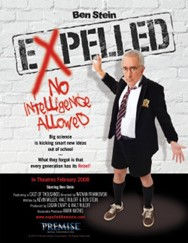
The other night I saw the film Expelled: No Intelligence Allowed.
I left the theater reminded of Mary McCarthy’s famously hyperbolic condemnation of Lillian Hellman: “Every word she writes is a lie, including and and the.”
Expelled was, as one would expect, an attempt to put forward the familiar, but patently false, idea that there is a serious debate within the scientific world between advocates of the neo-Darwinian synthesis and “intelligent design.” As its title indicates, the film’s particular twist is the claim that scientists are being fired, or denied tenure, or losing research funding, merely for taking seriously, let alone believing in, intelligent design.
So far as I’m able to ascertain—not being personally involved in any of the events in question, but relying on sources I take to be prima facie reliable—the accounts of alleged persecution are for the most part presented with cynical contempt for the truth. However, the sources I regard as reliable generally are the voice of the very scientific establishment that the film charges with conspiring to suppress the evidence for intelligent design and silence its proponents.
So the important question to ask is: What if scientists were penalized for being involved in intelligent design? Would this be warranted, reasonable, and in keeping with professional ethics? Or, as the movie strenuously insists, would this be irrational and unethical persecution of these beleaguered individuals by the desperate defenders of a theory in trouble?
Among the cases the movie presents, the one that comes closest to plausibility is that of astronomer Guillermo Gonzalez, who in 2007 was denied tenure at Iowa State University. Although the official reasons given for the denial of tenure make no mention of Gonzalez’ involvement in the intelligent design movement, the allegation that this was taken into account by those who turned him down is at least not obviously false. He did submit his intelligent design promoting book, Privileged Planet, as one of the publications for his tenure evaluation. So assume, for the sake of argument, that this professor was denied tenure in virtue of his adherence to intelligent design. Would this be objectionable?
A principal theme of Expelled is that it would be objectionable, indeed, it would be un-American, since we have a right to free speech that such penalties violate. (In fact, an aim of the film is to inspire support for “academic freedom” legislation designed to give proponents of intelligent design the platform their peers in the scientific world deny them.) One need only state the assumption that imposing sanctions on a scientist for what he says or writes is a violation of his right to free speech to see its absurdity. What scientists teach and write is subject to critical evaluation by their academic peers and, if it falls short of the standards of the relevant discipline, they are rightly subject to various sanctions: the individual might not be hired, not tenured, not promoted, not published, or not granted funds for research. As an American citizen, Gonzalez has a legal right to say pretty much whatever he pleases, irrespective of the quality of the evidence—if any—for his claims and irrespective of the quality of the scientific reasoning—if any—that he adduces on their behalf. However, if, e.g., he were to publish a book contending that the planets and stars are embedded in crystal spheres that move around a fixed earth, his colleagues would not violate his right to free speech were they to judge him unqualified as an astronomer and decide that he should ply his trade elsewhere. The right to free speech does not entail a right to be tenured when your colleagues believe you propagate bogus science.
So, let’s again move to the interesting question, which is whether the academy’s “punishment”—whether real or imaginary—of advocates of intelligent design, could be justified. What’s on reflection salient to anyone who sits through Expelled is that this crucial question is simply ignored. We are repeatedly told that there is a great controversy sundering the scientific world, and that those on one side of it are unjustly persecuting those on the opposing side, but we are offered not a single example of the scientific evidence that has created this crisis. Surprisingly absent are the usual claims about “irreducible complexity;” even the famous bacterium flagellum has motored out of sight. Although William Dembski figures prominently, “specified complexity” and natural selection’s inability to achieve it is merely alluded to. There is no attempt to make the case. What the movie offers instead is supposed experts confidently telling us that evolution obviously is a theory in crisis, and that many in the scientific community have grave doubts about Darwinism, but for fear of persecution reveal these doubts only when suitably inebriated. (I’m not making this up.) The informed viewer knows that this is close to being the exact opposite of the truth, that the case for the neo-Darwinian synthesis is today stronger than it has ever been, and that confidence in it among the scientifically informed (at least when they are sober) is at an all time high. This does not entail that evolutionary theory is true, but it does entail that the main claim of Expelled is false. The uninformed viewer will not notice, and I assume is intended not to notice, that most of those telling us that evolutionary biology is a theory in crisis are philosophers or mathematicians, not scientists, let alone biologists, let alone evolutionary theorists. However, the wells are well poisoned: the complete absence of substantive evidence for the alleged crisis and controversy is implicitly enlisted as evidence of the conspiracy of silence and the effective supression of dissent.
I have so far referred only to the first half of the movie. The second half passes beyond garden variety intellectual dishonesty into sheer propaganda. It features Ben Stein wandering through Nazi death camps, promoting the idea that this is where Darwinism leads. Between the film’s beginning and end Darwinism mutates from a possibly faulty theory some scientists are in trouble for questioning to an unmitigated evil that threatens civilization. Along the way we are told that Darwinism implies there is no God, no morality, and no freedom. All this is put forward as simply obvious, with no regard for reason or history. Particularly egregious is an attempt to show that Darwin himself supported what later became eugenics by means of a patchwork quotation from a passage in which he says the opposite.
Unlike Ben Stein, the film’s star and narrator, most of those who advocate for “intelligent design” are evangelical Christians. As a colleague pointed out to me, the typical viewer, hearing highly educated and articulate fellow Christians confidently describing the great conflict in science and the evil conspiracy to hide it, will find it impossible to believe they are not telling the truth. And that, I think, leads to the serious question: Why have evangelical Christians, who are not always merely moralistic but often actually moral, concluded that dishonesty is permissible? Why has it become O.K. to lie for Jesus?
I believe that the “intelligent design” movement has been a disaster for Christianity. Prior to the 1990’s most secular academics were dimly aware of old-style creationism, something associated with the Scopes trial and the benighted fundamentalism of rural America. The intelligent design movement changed this. Its proponents had the credentials and wherewithal to seek a “place at the table” and get their ideas under discussion in respectable academic circles. (My view is that by and large, the secular academic establishment bent over backwards in an effort to give them a fair hearing.) These ideas received the respectful, but highly critical, treatment that was their due. However, the debate did not evolve in the normal matter, with each side paying heed to the arguments of the other side and trying its best to respond honestly to them. Instead, so far as most academics were concerned, the issue rather quickly became not the issues themselves, but the evasiveness, obscurantism, and downright dishonesty of the anti-evolution side. In the eyes of the intelligentsia, Christian critics of evolutionary theory are shockingly willing to prevaricate for their cause. This was, no doubt, exacerbated by the blatantly dishonest attempt to introduce intelligent design into the public schools as a supposedly non-religious alternative to Darwinism. One reads the court documents of Fitzmiller v. Dover Area School District appalled at the willingness of evangelical Christians to commit perjury in the effort of get a mere nod to intelligent design into the science classrooms.
The film Expelled is simply the latest, and a particularly sordid, instance of the forces opposed to evolution presenting a mendacious face to the world. Yet many of those opposed to what contemporary science tells us about human origins are good, honest people. Why do good people tell lies? Many, of course, are not lying but merely repeating what people they trust have told them, people who are, in turn, sincerely repeating falsehoods they have heard from sources they trust. But at some point the trail leads to those who surely know better. Why do these presumably otherwise honest persons judge that deceit is acceptable when it comes to the theory of evolution?
The closest I’ve been able to come to grasping this is the analogy of the district attorney who is utterly convinced of the guilt of a suspect, but frustrated with a judicial system that makes it impossible to convict him with the admissible evidence. As we know, otherwise ethical individuals in these situations sometimes go wrong, suppressing exonerating evidence and even fabricating evidence against the culprit. Such wrongdoing, they feel sure, is justified if that’s what it takes to keep a dangerous criminal off the street. Maybe individuals like the makers of Expelled are so convinced of the “guilt” of Darwin, Dawkins, and their ilk that they feel justified in dealing with them and their ideas deceitfully.
Beyond this, the paradigmatic situation in which ethical people believe dishonesty is permissible, or even obligatory, is war. In a just war, it can be permissible to lie to, and tell lies about, your enemy. Perhaps what we’re now seeing is an ugly effect of the “culture wars” mentality. This could explain the surreal disregard for the truth that has come to characterize religious opponents of science. They see themselves at war with the horrendous evil of Darwinism, a war in which everything is at stake and “all’s fair.” It’s perfectly O.K. to deceive Dawkins and other interviewees about the nature of the film, just as it’s perfectly O.K. to ascribe to Darwin views plainly opposed to his actual words, it’s perfectly O.K. to distort the facts about proponents of intelligent design being fired or denied grants, and it’s perfectly O.K. to proffer a totally fictional account of the current status of evolutionary theory in the scientific community. However, what this deplorable business has to do with faithful Christian witness is, obviously enough, precisely nothing.

Comments