UFOs
- wacome
- Sep 15, 2021
- 6 min read
Updated: Dec 10, 2021
I believe that skepticism is called for in regard to the belief that UFOs are in some cases spacecraft from extraterrestrial civilizations. By this I mean that while this interpretation is not impossible, it is very improbable and current evidence does not overcome that improbability.
(The U.S. government now uses the acronym UAPs, for unidentified arial phenomena, thus properly avoiding the presupposition that they are material objects. Not all aerial phenomena are material objects, e.g., a rainbow is a merely phenomenal aerial object. Most people discussing the matter simply take it for granted that what’s detected in these cases is some sort of material object, but to do so is a mistake.)
My skeptical view does not arise from the belief that we are alone in the universe. On the contrary, I believe that there is intelligent life elsewhere in the universe, and that it is likely that there are spacefaring civilizations out there. (I believe this in part for theological reasons. See my The Material Image, Chapter 4.)
However, I also assume that intelligent life, and perhaps life itself, is an improbable phenomenon in the universe, and thus that alien creatures capable of paying a visit to the Earth are, in relative terms, exceedingly rare. This does not conflict with the idea, which I also believe, that in absolute terms, there are a great many intelligent species in the universe. For example, intelligent life might be so rare that it occurs about just once for every 100 billion star systems, i.e., about once per galaxy. Relatively speaking, this makes intelligent life exceedingly rare. However, it also makes it superabundant in absolute terms, since the observable universe contains at least two trillion galaxies. This would imply civilizations are generally few and far between, so it should not be a surprise if none ever come into contact with us. To this we must add the implications of the vast age of the universe. The number of intelligent species now existing somewhere in the universe is, presumably, a fraction of those that have existed but no longer exist, or will but do not yet exist. Great civilizations might have come and gone a billion years before the Earth existed. Others might be yet unborn. The Earth has existed for about 4.5 billion years; if visitors from the stars had arrived during almost all of that time—humans have existed at most for a few hundred thousand years—we would not have been here to notice.
Further, I do not find it incredible that extraterrestrials could make the trip, at least by proxy. Even given the constraints on the speed of travel described by special relativity, which mean it would take huge amounts of time to travel between the stars, let alone among the galaxies, advanced extraterrestrials could have sent out self-replicating automata to have by now explored much of the universe. However, a reasonable assumption is that these devices would be microscopic, economizing on mass and materials. They could be here yet not noticed. But, as above, it would be improbable if they come by just when someone is here to see them, rather than, say, one million years ago, or one million years in the future. If there is some loophole--wormhole?--in the constraints of relativity, or if ETs are so different from us biologically as to be so long-lived as to take fantastically long space voyages, then aliens could turn up here in person. Given the vast number of star systems and of planets in them, we should wonder why they would show up here, as well as now. Our sun is, obviously, the sort of star that makes life of our sort possible. This might make our solar system of interest though, among stars conducive to life as we understand it, ours is rather nondescript. One exception is that for about the last 70 years the Earth has been an exceptionally bright source of radio transmissions in the FM range, thanks to the advent of television. That could make us stand out, but only within a sphere of about 70 light years, which is a relatively tiny patch of our galaxy, let alone the universe. Presumably, this unintended signaling will stop before long as over-the-air broadcasting is replaced by media that have much greater bandwidth, such as cable. Thus, our being a beacon at these radio frequencies, in fact the brightest in the Milky Way, is transitory.
One reason for skepticism is the way the ET visitors, if that’s what they are, behave. Presumably, if they have the technological capacity for interstellar travel, they could remain unobserved. And, if they wanted to make their presence known, they could do so. What seems unlikely to me is that they would, over many years, flit about in the Earth’s atmosphere, episodically, but never unambiguously, observed. Of course, the motivations of non-human persons need not be intelligible to us. But if we invoke this consideration, we cannot reasonably point to the fact that they are observed so frequently in the vicinity of military installations or naval forces at sea. Casing the planet’s defenses would be an entirely understandable human motive. I suspect that the concentration of these sightings at these locations is a selection effect: that’s where there are powerful and sensitive IR video cameras that can detect, say, the odd look of the IR glare of a civilian jet’s engines at a extreme distance.
I don’t find it plausible that the United States government knows about alien visitations but conspires to keep them secret. There is a general culture of secrecy, in which many things are classified for no good reason, and this may well include whatever uninteresting findings the military has on UFOs. Some believe that the government knows of the presence of space aliens but keeps it secret lest the public panic. It seems more likely that if the government knew, they would try to convince the public that only it can keep us safe, and it would demand more funding and greater power for that purpose. (Absurd Hollywood productions to the contrary, it’s highly implausible that a civilization possessing the technology for interstellar travel could be effectively combatted, should they choose to attack. But absurdity is not always an impediment to government policy.)
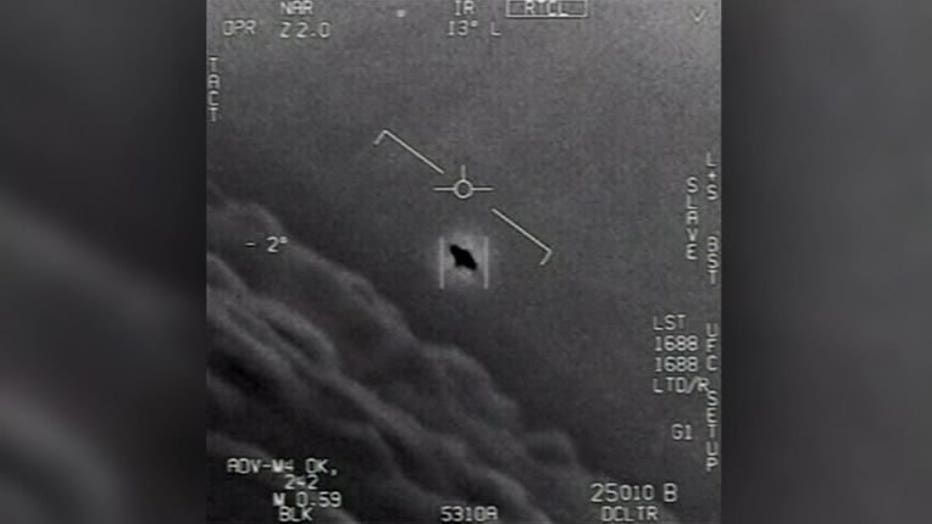
Insofar as we have evidence worth taking seriously, it consists mostly of heat signatures recorded from infrared cameras, low-quality video of indeterminate blobs of light in the sky, and testimony of correlated naked eye observations and, in some cases, of radar tracks. (Unfortunately, the military does not share recordings of radar images with the public.) Many interpret these phenomena as material objects, sometimes moving at velocities no known human technology can achieve and in ways that are, in light of our current understanding of physics, impossible. In the absence of evidence to the contrary, we should accept these reports as made in good faith by rational individuals. But the fact that an observer, no matter how skilled and intelligent, interprets what he saw, either directly or via a camera, as something far out of the ordinary, gives us little reason to accept that interpretation at face value when the interpretation is a priori improbable. Very few of us have a robust conception of the many ways in which human perceptual systems can be misled into not seeing what is there, seeing what is not there, or taking one thing for something else. A well-known example is the “invisible gorilla” experiment, in which most of us simply fail to see someone in a gorilla suit running around on a basketball court while we are attending to what the players are doing. This is amusing, but the real-life consequences can be deadly, as in the tragic case of the experienced pilots on the runway at Tenerife, who simply failed to see the airliner right in front of them. The collision that resulted was the worst disaster in the history of aviation, with a death toll of 583. Expectations, as well as unusual viewing conditions, readily lead to very convincing, but mistaken, interpretations of what is seen. Note that proponents of ET interpretations of recent phenomena often appeal to the authority of highly trained pilots, convinced they have seen something not of this world. An excellent introduction to the mind’s vulnerability to error is Sleight of Mind: What the Neurocience of Magic Reveals about Our Everyday Perceptions, by Stephen Macknik and Susan Martinez-Conde (sleightofmind.com). The authors are cognitive neuroscientists who have worked closely with professional magicians, experts at manipulating human perception. All of us have been subject to optical illusions, when what we seem to see is not, and in some cases cannot be, what we seem to see. An unavoidably simplified view of the physical world and of the human perceptual system (as well as of the vagaries of photography) can render exotic interpretations of unexpected but mundane phenomena utterly convincing. However, the careful application of this realization to the recent spate of UFO videos that produce compelling “debunking” explanations should make anyone skeptical about popular interpretations of these phenomena. See, e.g., Mick West’s work on the recent UFO videos (on Youtube).



Comments