Homilies for Last Pentecost/Christ the King
- wacome
- Mar 28, 2021
- 17 min read
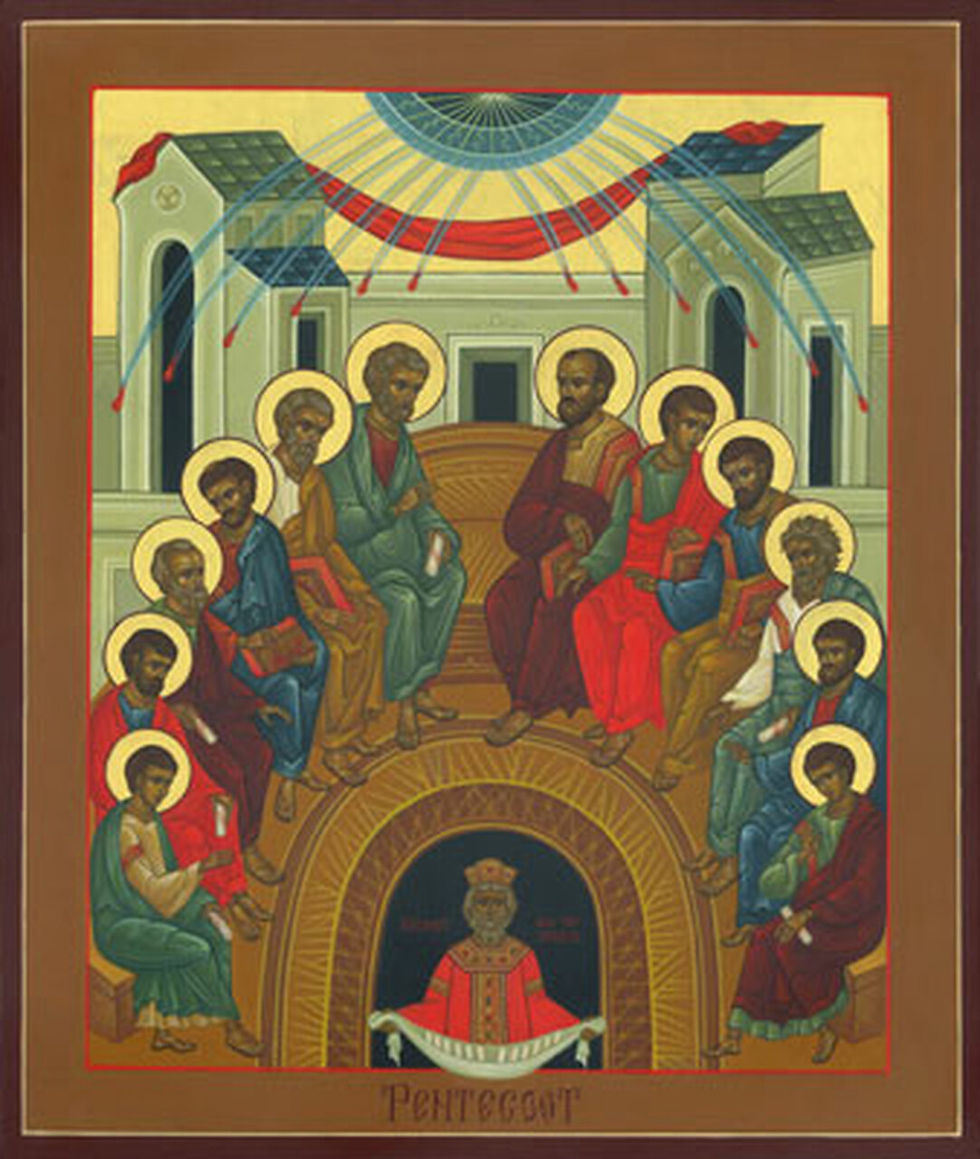
Christ the King Sunday
(Last Sunday after Pentecost)
22 November 1998
St. George’s Episcopal Church
Le Mars, Iowa
Luke 23.35-43
Fear and Loving in Las Vegas
“
He saved others, let him save himself!” Luke 23.35a
The last Sunday after Pentecost - the last Sunday before Advent - is the feast of Christ the King: the celebration of the authority of Christ over all creation. So consider our Christ, king of creation. Forever in the depths of the past the triune God, Father, Son and Holy Spirit, not the monolithic unchanging deity humans might imagine but a community of love that has always been and is yet always new, a community of mutual giving, sharing, subordinating and glorifying in undivided unity; a great eternal dance of infinite joy. This is the true God who called into being what wasn’t and had no need to be. Our creator had no need or duty to create; he’d have been no less good, no less full and complete had he created nothing. But, because his nature is love itself he chose in freedom to bring our world, and with it us, into being. He intended from the beginning the existence of creatures like us, made selves invited to share in the trinity of everlasting, overflowing love.
Fourteen billion years ago: the creator spoke and bursting out of the darkness there was the Great Light (better to call it that than the ‘Big Bang’): it was for our sake. We were not yet but the world was forming itself to be our home: exploding into shape, cooling and growing, the cosmos giving birth to the elementary particles, then the stars that flamed forth for eons and in dying brought forth the stuff of which we would be made. The subtle interplay of law and chance framing the intricacies from which at last the simplest life formed and then, in the fullness of time, creatures of heart and mind and soul, God’s very image crafted of dust and flesh, ready to know and love their creator. Created to join him in the endless joy. The power of creation is the power of love giving itself.
The glorious creator called this universe into being for our sake, so we could share in the fullness of love that he is. But that’s not the whole truth. We must consider the cosmic Christ, king of creation: we read that it is for his sake that the worlds exist, that all things were created for him and through him...in him all things hold together (Col. 1.16-17). This means we don’t see the aim and purpose of creation until we see that it is created for the Christ. Indeed, while it’s not an ‘official’ part of Christian theology, there’s a long tradition that says the creator’s original intent was always to become flesh, to come to dwell in his creation, to dwell among the creatures for whose sake all that is made is made. God incarnate explains the creation. The incarnation of Christ is not a remedial measure, an afterthought, a second best, but the reason for, the meaning of, the whole. Jesus Christ, God incarnate, the king of creation.
And yet: today’s Gospel reading is cruelly at odds with this vision of Christ the king. We see not the glorious creator Christ but Jesus humiliated. Not God as a human being raising all of us into the everlasting communion of joy, but God as tormented flesh cast into the world, despised and desolate. Not creation honored and glorified by God’s very presence within it, the creator mocked, dishonored, brought down. “He saved others; let him save himself!” God the powerful creator, by whom and for whom all things were made, treated as a thing of no account, good for a bit of sport, then disposed of on the edge of town and forgotten. The God whose love caused the cosmos to well up into being from nothing made powerless and destroyed by fear and hate.
We know, of course, that the power of God’s love was not defeated. We know that the weakness held up for all to see on that cross only hid the power of God’s love. We rightly speak of the power of self-sacrificing love, what Jesus on that cross above all symbolizes, because in the end he’s not only the best symbol of it but the reality itself. If we want to see the God whose self-giving love created all things the best place to look is that horrendous scene from today’s Gospel reading.
We know we cannot separate the love from the power; Jesus abused on the cross from Christ the king of creation. But it is hard to keep them together.
Love that gives itself for the other is a wonderful thing even when it is powerless. I haven’t see it more vividly - more poignantly - portrayed recently than in the film Leaving Las Vegas. This is a hard but beautiful movie. Nicholas Cage plays Ben, a once successful Hollywood screenwriter in the terminal stages of drinking himself to death. Having lost all hope, he leaves L.A. and heads to Las Vegas for a final bout with booze that will complete his course of self-destruction. But in Vegas he meets Sera, a streetwalking prostitute (played by Elisabeth Shue). In her own way Sera is as hopelessly self-destructive as Ben. She seems as bent on selling herself to death in rough trade as Ben is on drinking himself to death. These two lost souls cling together as Ben descends into the abyss in an alcoholic haze against the hellish glare of neon-lit Las Vegas. For a time the viewer thinks their love might save them; for a time their closed worlds of pain begin to open up as they give themselves - despite themselves - to one another. This self-giving love comforts, but in the end it doesn’t heal; it consoles on the way to death but in the end succumbs. The love affair was predicated on the agreement that in the end Sera will not interfere with Ben’s killing himself, but inevitably she begins to hope her love has the power to bring him back from the edge. But finally she realizes it cannot bring life from death. The powers of death overwhelm them both and she says “I love you enough to let you die.” And he does.
Leaving Las Vegas is a great film. Hollywood so often sells consoling fantasy about the human condition but here it unflinchingly shows hard truth. The best we have to give each other is not enough. We can save neither ourselves nor one another. There is loving in the Las Vegas the movie portrays but it cannot cast out the fear. Only the power of God can do that. Only the power that brought the worlds into being from nothing can bring us out of death into life, out of weakness into strength and out of fear into hope.
Ben and Sera’s self-giving love is a worthy thing, fragile and ultimately hopeless though it is. When all is said and done it is perhaps the best thing we humans on our own are capable of. But the love Ben and Sera have for one another is a love that cannot draw on the power of Christ the King. Jesus does not just die for us. He does not just give himself for us. His life and death is a power greater than whatever we fear. Today as the Advent of the Christ approaches we have reason to celebrate him as King of Creation, the resurrected Lord of all that is.
Our faith is not mere consolation. We celebrate the presence of Christ with us this morning because we trust in a love that is mighty in its power, a power that speaks to our weakness and takes away our fear. Christ our suffering savior, Jesus our powerful creator and king, alone has the power to heal all that is broken in us and redeem all that is lost. Let’s ask for ourselves what St. Paul asked for the Colossians: may we be strong with all the strength that comes from his glorious power.
Amen.
his visit to Earth a secret, and made his way to the resistance. (From Hasidic Tales of the Holocaust, Yaffa Eliach as related by Joel Marcus, Jesus and the Holocaust.)
This is the story that came to mind when I read the lesson for today from St. Paul’s letter to the Galatian Christians, with its amazing assertion that we wear Christ like a suit of clothes. The Greek word literally means simply “to put on,” but as in modern English, it’s regularly used to express the idea of putting on an article of clothing.
Desperate Zvi Michalowsky at the door of the superstitious old woman: clothed in Christ. Beyond all hope, despised and hunted, as good as dead, already having been in the grave, preposterously out of place ― how enraged those ‘good Christians’ who wanted him dead would be if they knew his imposture ― yet saved because he is absurdly mistaken for Christ. The story is deeply ironic, turning St. Paul on his head, for it’s we gentiles who are saved by passing ourselves off as the suffering Jew, the Christ of Israel, the crucified God. It’s us, disguised as Jesus, unnaturally grafted on to God’s people, made heirs of Abraham according to the promise.
We are clothed with Christ. When God looks at us he sees not what’s wrong with us but what’s right with Jesus. He doesn’t see someone contemptible, lost, hopeless, dead. When God sees us he sees not our faithlessness but the perfect faithfulness of his son. We’re taught to think about God as all seeing, all knowing. When I was a boy, this was a way to keep me in line: even when no one else saw what I was up to, God had me in his sights. He doesn’t miss a thing, and I’d get what I deserved. But Paul’s talking about what God doesn’t see: when God looks at you and me he can’t help but see the face of Jesus. Rather than seeing what’s wrong and wayward in us God our Father sees us as his well-loved children; he loves us as he loves God the Son. Wearing Jesus, we are loved by God as God loves himself, lifted up into the joy-filled life of the everlasting Trinity.
Putting on Christ, we can begin to see ourselves as God sees us. In Luke’s gospel we find the disciples, no doubt priding themselves that, unlike the crowds, who have no clue who Jesus is, but imagine he’s the latest in a long line of prophets, they know he is the Christ, the Messiah, the unique embodiment of God’s so long-awaited deliverance of his people. Yet they don’t understand. They have big ideas about being on the winning side in the coming showdown with God’s enemies. But Jesus cuts them off with his grim prediction of rejection, suffering, and death: their conception of what it means to be the Messiah is radically at odds with God’s. He says his way is the way of the cross: “If any want to become my followers, let them deny themselves and take up their cross daily and follow me. For those who want to save their life will lose it, and those who lose their life for my sake will save it.”
What does it mean to deny yourself? I think part of it is that we’re called to forsake our confidence in those things about us that we can’t help feeling rate God’s approval, those things out of which we naturally construct our identities as worthwhile human beings. Those things might be all well and good, but the crucial thing is that they don’t even show up on the radar of God’s loving acceptance of us. Nothing counts here but putting on Christ. We’re always tempted to find something else to wear, some more plausible means of making an identity for ourselves, something more fashionable, or more flattering to our best features, but that’s to reject God’s saving grace in favor of an illusion, a fantasy. In the theological language of the Reformation we’d say Christ’s righteousness is imputed to us, his ‘alien’ goodness reckoned as ours by grace, through faith. Pushing on St. Paul’s metaphor, we might say God’s throwing the mother of all parties; it’s a costume party, and there’s just one costume that gets you in the door.
Paul in Galatians goes on to say there’s something else God doesn’t see: the difference between Jew and Greek, slave and free, male and female. The differences that were once all-important, sorting people into those included in and those excluded from God’s loving gaze, recede into insignificance. No matter what we are God regards us as his own, in Christ, inseparably bound to him. We are one in Christ.
To deny yourself, to be ready to lose your life is, I think, to be willing to push anything, no matter how important, into second place, to treat what’s dear to you ―because you know it really does matter a lot― as though it doesn’t count, rather than let it divide people for whom God in Christ gave himself. God wants us to see the way he sees. He sees Christ in us and us in Christ and that’s how he asks us to see one another. Gerard Manly Hopkins’ great poem “As Kingfishers Catch Fire” concludes:
For Christ plays in ten thousand places,
Lovely in limbs, and lovely in eyes not his
To the Father through the features of men’s faces.
These concerns are perhaps especially pressing these days, when our church has become a battleground in the ‘culture wars.’ Great things seem to be at stake, matters that threaten to dissolve the unity of our common confession of Jesus Christ. We give lip service to God’s insistence on unity in Christ, but we really see the issues of the day as essential, as exceptional…as more important than the fact that God looks with absolute love upon them no less than us.
Archbishop Rowan Williams, speaking at York Minster last summer, said:
The irreducible fact about the brother or sister [is] that Christ died for them and that the Spirit wants to give something through them. To cling to unity is to cling to those convictions, especially when everything in us cries out for separation …our life with Christ is somehow bound up with our willingness to abide with those we think are sinful and those we think are stupid.
God for Jesus’ sake forgives and accepts us with no strings attached, refusing to let the zillion ways we are inadequate, disloyal, wildly wrong, plain foolish and a menace to all that’s sacred get in his way. That this is the way God deals with us might seem pretty crazy, as crazy as the story of an old Lithuanian woman believing that the Jewish teenager at her door was Jesus Christ. And it might seem almost as crazy to believe that this is the way he expects us to deal with one another. It seems like a joke, as though God is putting us on. But it’s the gospel truth.
Amen.
Last Sunday in Pentecost
24 November 2002
St. George’s Episcopal Church
Le Mars, Iowa
Matthew 25.31-46
The Sheep, the Goats and a Couple of Cats
We arrive at the end of the season of Pentecost with a pivotal scene in Matthew’s Gospel.
Probably, the passage does not record Jesus’ actual words, but instead is of Matthew’s own devising, part of his attempt to craft a portrait true to the meaning and purpose of Jesus. That he places them here, at this key juncture, as Jesus’ last words to the leaders of Israel before they make the final decision to kill him, suggests he intends them to sum up and clarify everything Jesus has been saying all along.
But what is it he’s having Jesus say here? The most obvious interpretation, the one that thanks to our natural assumptions about God as well as much of our experience with religion is ready to leap to mind, is a conventional picture of divine judgment, salvation and punishment. It might be that after all the odd and disturbing parables that have led up to this, Jesus’ story of the sheep and the goats comes as a relief. Here at least he’s making sense: God wants people to do the right thing; if they do it, they go to heaven for their just reward, if they don’t, they go to hell to be deservedly punished. God as condemning judge is deeply, dangerously engrained in us. Anne Lamott in Bird By Bird (30) reminds us of our constant need to escape that pervasive image of “God as the high school principal in a gray suit who never remembered your name but is always leafing unhappily through your files.”
Fortunately, this ever popular, superficially plausible reading won’t work. There is, of course, the fundamental problem it poses for any thoughtful Christian faith, which categorically rejects the whole idea of salvation as a reward for being good and damnation as a punishment for being bad. How could we square that with St. Paul’s glorious affirmation of salvation for everyone by God’s grace alone that Mike read a few minutes ago: “For as all die in Adam, so all will be made alive in Christ!” (1 Corinthians 15.22). Isn’t Paul saying that my standing with God is no more a matter of my doing good than my death in Adam – my alienation from God – is a matter of my doing wrong? Salvation – being accepted by God – is by grace, through faith in Jesus; it’s not a reward for goodness, not even for being kind to strangers or generous to the needy.
Even on its own terms, it’s hard to find in this text a sensible version of the conventionally religious meaning. What is it, after all, that qualifies you as a righteous sheep, rather than an unrighteous goat? It looks like it doesn’t take much: just a bit of casual help to someone. Has anyone ever lived a life of such unmitigated selfishness as never to have done some small, helpful thing? I bet that the worst people we can think of could count as sheep if that’s all it takes. Glass of water for the thirsty? I’ve known some pretty lousy characters who, in a magnanimous moment, would gladly buy a whole round of drinks! On the other hand, who is so consistently kind as never to have turned away from a chance to help someone in trouble, never crossed the street to avoid yet another panhandler, never been too busy to listen to someone’s hurt, never put one’s need to get work done, or to get some rest, or privacy, ahead of a broken world clamoring for attention? So it looks like we all end up being goats too. If Jesus is setting out the standard on which we’ll be evaluated for being in with, or on the outs with, God, then it’s a crazy kind of test, one everyone fails, and everyone passes.
Before we try to apply Jesus’ story of goats and sheep to ourselves, we need to remember what it would have meant in Jesus’ actual situation. Jesus is not a theological teacher, spelling out general principles about salvation. He’s the messiah of Israel, on the verge of being decisively rejected. He’s the dispossessed king, facing the fact that his people are, by forsaking him, choosing their own destruction. At the same time Jesus speaks here in the line of the great prophets of the Hebrew scriptures: calling the people to God, warning them of impending doom that cannot be averted except by repentance that gives up all attempts to find righteousness, strength and life outside the grace of their ever-merciful God. That doom is not some by-and-by cosmic apocalypse, the ‘end of the world’, the last judgment, but something concrete and historical, something clearly foreseen by anyone capable of reading the signs of the times, signs written in the plain and very worldly language of power politics. Over and over Jesus says, “turn to the God whose messiah I am and be saved, or soon enough the evil empire will crush you. Your only identity, your only future, lie in being God’s elect people, people of the God revealed to you, fully and at last, in me.” Jesus confronted powers and authorities who rested secure in their scrupulous ritual purity, their close adherence to the law, their strict moral integrity, expressed all too often in their readiness to condemn and exclude the foreigner, the unclean, the leper, the harlot, and the beggar, to subjugate women and marginalize the powerless. Jesus confronted a religious establishment that counted on its righteousness to guarantee divine vindication when, at last, it rose in triumphant rebellion again Rome. To them, Jesus is nothing but a traitor, foolishly preaching peace, madly demanding that they love their enemies, outrageously enacting the kingdom he claimed to be ushering in, a kingdom where the gates are thrown open to all comers, the sinners, the unclean, the undeserving, the lawless peasants, the vile Samaritans, even – God forbid! – the filthy Roman swine.
At the risk of doing what the Baptists call “leaving off preaching and getting to meddling” I want to draw an analogy that might be more than an analogy. Consider the ongoing crisis in Israel today. Let me first be clear that I do not want to say that the Israelis are in the wrong and the Palestinians are in the right. I don’t believe that. In fact, I think it’s morally reprehensible to pretend that people who encourage adolescents to wire themselves with explosives and go blow up themselves and unarmed, unsuspecting civilians, diners in restaurants, worshippers at seders, children on buses, are in the same moral universe as the Israelis, whatever wrongs they have perpetrated against the Palestinians. Surely, the state of Israel has done some rotten things, well worthy of criticism, but overall it seems to me their response to the suicide bombings is remarkably restrained. Imagine the way the United States would respond if such attacks were scaled up in proportion to our much larger population: I think it likely that there would be a decisive, and devastating, military response far beyond anything the Israelis would dare. We just wouldn’t put up with what Israel puts up with. So far as this world’s ways go, I don’t see them as doing so badly in a tragic and messy situation in which no one has a prayer of being completely in the right.
And yet: we can imagine, and even hope for, a radically different reality interjecting itself into this wretched situation, a prophetic voice that contends against an Israel that seeks its security in its economic and military prowess, in its alliances with great powers, or in the moral or legal justification of its actions, a voice that warns that the course it is on is not the way of Yahweh, but a way that leads inevitably to ruin. Its national salvation lies not on the path that dispossesses the weak and destroys the enemy, no matter what the justification, but on the path of reconciling forgiveness, the risky path that puts its hope against all odds in the merciful love of God.
This, I think, is the background against which we should hear what Jesus says about the sheep and the goats. His final word to the religious leaders contrasts the kingdom they embrace with the one they reject. The kingdom they so earnestly defend as God’s very own is in fact where the poor are despised, the stranger shut out, the kingdom in which the rules matter more than people, people are kept where they belong and get what they deserve. We always have to remind ourselves how much in that world the poor, the lawbreakers, foreigners, the sick were one way or another seen as cast out by God and cursed, as rightly avoided and despised. Jesus pronounces that kingdom’s doom. It is on its way to death and destruction because, in its desperate need to make itself right and righteous, it cuts itself off from God. The kingdom they reject in rejecting its king is the kingdom where one’s willingness to welcome the stranger, visit the prisoner, help out those in need, rather than putting one’s purity and one’s good standing with God at risk, instead connects us to the very life of God, the God who welcomes us though we were strangers, who frees us from our prisons, heals us, feeds us, clothes us and makes us whole. This is the kingdom that has an everlasting and happy future, because it is the kingdom of the God whose love knows no limits.
The great line between the saved and the damned, between the kingdom of God and the kingdom of this world, between the sheep and the goats, runs not between people but through them. I’ve seen self-help literature that advises me to get in touch with my inner child, and with my inner woman. (I’m pretty sure she’s not in there!) Today’s text points us to our inner goats. The goat in me worries about being good enough for some sort of God cooked up out of my secret hopes and fears, he feels lost if he’s not satisfying expectations, justifying himself, and drawing lines between those who do, and those who don’t, get things right. But there’s a sheep there too. He’s often timid, lacking in initiative and, well, pretty sheep like. But he knows the whole goat approach to life is on its way out, and that the future holds the triumph of grace. He gets pushed around a lot by that old goat, but he knows the Lamb of God who forgives, and takes away, the sin of the world.
Those lines run through the church too. In fact there might be nothing like the Christian religion for giving our inner goats room to maneuver. There’s the story of the rector who had an argument with a member of the vestry about whether a certain woman who had a bad reputation should be made welcome in the church. The minister finally said, “Well, didn’t Jesus forgive the woman taken in adultery?” “Yes,” replied the vestryman, “but I don’t think any more of him for having done it.” So much that bears the label ‘Christianity’ amounts to the attempt to coerce people into behaving themselves so as to make God approve of them. As if we need only tell people what they ought to do often enough, loudly enough, threateningly enough, and they’ll do it. When, to our frustration, they don’t, then we judge, condemn and exclude. In theological terms, the law becomes a weapon we use to try to manage other people, ourselves, and finally God. Faith in the crucified Jesus devolves into an apparatus of judgment, condemnation and control. But of course it’s hopeless: we’ll never make anyone, even ourselves, any better by hitting them with that stick. FitzSimons Allison (Fear, Love and Worship, 51) tells the story of a sergeant who during World War Two told a grim joke to his trainees: A man stopped on a dirt road to help get another man’s car out of the ditch. The man was starting to harness two small, furry cats to the bumper of his huge car when he asked, “Mister, you aren’t trying to get those cats to pull that car out of the ditch, are you?” His reply was, “Why not? I’ve got a whip!”
Human beings, all of us, wounded and wicked, are moved at last only by the power of God’s great mercy, his indiscriminately forgiving love. So let’s stop feeding that inner goat, stop whipping the cats, lose the stick and put our faith in our gracious God.
Amen


Comments