Homilies for First Sunday in Pentecost/Trinity Sunday
- wacome
- Mar 28, 2021
- 43 min read
Updated: May 30, 2021
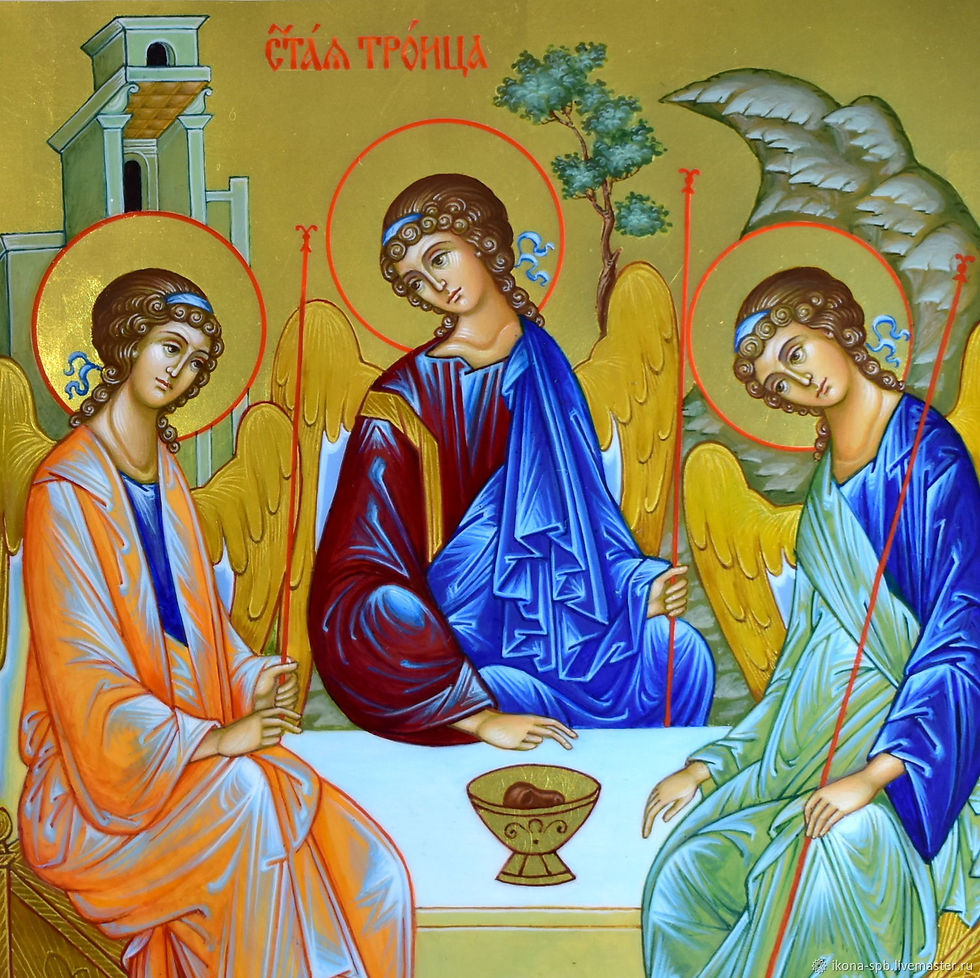
Trinity Sunday: First Sunday After Pentecost
6 June 1993
St. George's Episcopal Church
Le Mars, Iowa
Matthew 28:16-20
Doubting Disciples
"When they saw him, they worshipped him; but some doubted." (v. 17)
It's not clear in this passage from St. Matthew's gospel exactly who is doubting. Are all eleven disciples worshipping and others, not mentioned elsewhere in the text, doing the doubting? Are some of the disciples just worshipping and others just doubting? Are some of the disciples worshipping and doubting at the same time? It's not obvious how to resolve the ambiguity. I like to think of these disciples, in the excited, confused aftermath of the resurrection, with worship and doubt alive in them all at once. Because this makes them like us; at least like us some of the time. I imagine myself being there, at first openly skeptical of the two Mary's wild claims about Jesus having somehow defeated death, but secretly hoping against hope there might be something to it. Hopeful enough to have come up to Galilee just in case. Then, suddenly, there he is and I am falling down, recognizing the risen Jesus for who he is and, in worship, acknowledging him as God with us. But at the same time I'm wondering "Could this really be true? It looks like the man I knew and loved...could it really be him? What are the implications of that? Who, then, would he be? What if it's just wishful thinking? My need and grief fooling me? Isn't this too crazy? A trick, an illusion? Too good to be true? I don't want to be taken in. Not again..."
However we interpret Matthew's text, what's remarkable in it is Jesus' response to the doubters, whoever they were. At first he seems to ignore them. He immediately gives the disciples the 'great commission': "go therefore and make disciples of all nations..." It is quite easy for us to regard this as the sort of task appropriately given to faithful, confident worshippers, not to doubters. It seems natural for us to want to make sure our own doubts are resolved before going out to tell others. The great task of spreading the good news about Jesus seems one best reserved for those who are certain about it, for those whose worship has no shadow of doubtfulness. We assume proselytizing should be left to those who feel 100% confident about their message. To go out and preach when you're not totally sure about it seems like a good way to make a fool of yourself, or worse, a way to become a hypocrite and a charlatan.
Yet this doesn't appear to be the way Jesus sees it. His response to the doubters shows that what counts from his point of view -- and thus what counts in reality -- isn't having faith. As though faith were always and automatically a good thing. But this isn't true. Sometimes having faith in something or someone is a bad thing. It can be foolhardy, a manifestation of credulity or gullibility. It can be an evasion of personal responsibility for what one believes and does, a way to feel good about not making the effort to ask hard questions, listen to objections, or find reasons for what we believe. It can be an attempt to get certainty and security where there is none to be had. Think of the ill-fated followers of David Koresh. There was nothing laudable about their faith in him. It was only pathetic, not praiseworthy.
Faith in Jesus is at the center of Christianity, not because it is faith, but because it is faith in Jesus. What matters is not the strength or intensity of our faith but its object. Not that we trust, but who we trust. Our faith varies; it vacillates from being strong and confident, free of doubt, to being weak and doubtful, all depending on what we're feeling, on what we're experiencing from one day to the next. What is strong and reliable isn't what we do, but he in whom we trust, however shakily, however doubtfully. The weakest faith in the God revealed in the resurrected Jesus is greater than the strongest, most confident and certain faith in anything else. The answer to our doubt is not finally stronger faith on our part; it is the faithful one himself.
This is why it makes sense for Jesus to respond to his doubting disciples the way he does. He doesn't respond to their doubt judgmentally, admonishing them to try harder to believe. His answer to their doubt is to assign them a great and difficult task, one they have not the slightest chance of carrying out on their own. If they take his commission at all seriously, they are forced to see that their own powers, including whatever powers they have to believe what they are called upon to proclaim, are ultimately irrelevant. What he asks them to do is doable only because he will be with them as they do it.
Jesus does not simply instruct the disciples to go into the world, teaching people everywhere the good news. He gives a reason why they should do this. They are to go into the world making disciples because "All authority in heaven and on earth has been given to" Jesus (v. 18). Initially it isn't easy to see precisely what is the connection between Jesus' having been given all authority and the mission he gives his disciples. But I think it's something like this: if someone is an authority he or she is reliable, trustworthy, someone it makes sense to rely on. When Jesus says he is the only authority, he is saying he is the only thing in the world worth relying on, the only one ultimately worthy of our faith. Now that who God is has been demonstrated by the life, death and resurrection of Jesus, there is nothing else it could conceivably make any sense for anyone to trust. God's faithfulness to us has been proved by his willingness to be one of us and even to die for us at our hands. Of course people are ignorant, stubborn and fearful and will for a time at least go on trusting in the things people have always trusted in: their own good moral character, good luck, good sense, or having the right religion, or the right family, the right nationality, or the right amount of money in the bank, the right political convictions, or whatever: there's no limit to what we can grab on to to try to be right, and in the right; to be, in whatever by our lights is the final analysis, good enough. Jesus responds to our doubts by appealing to the trustworthiness of God made real for us in Jesus himself.
The reality of God's faithfulness renders whatever doubts we have of no final significance. In comparison to his commitment to us, our faithlessness is of no account. Our faith may be all but nothing, like the tiny mustard seed Jesus talks about earlier in Matthew's gospel. We may be like the desperate father of the possessed child who in Mark's gospel cries out "I believe, help my unbelief!" If God's loving and accepting us were some sort of reward for the strength and persistence of our faith in him, there'd be no hope for most, perhaps none, of us. If our ability to share in God's continuing work in the world depended upon our having a faith free of uncertainty, it would have been pointless for Jesus to give us the great commission. Our relation to God does not depend on our faithfulness, but on God's. Our ability to go and tell a broken world about the graciousness of God doesn't depend on the strength of our convictions, but on the faithfulness of God.
God's faithfulness was made vivid and concrete in the life, death, and resurrection of Jesus. But his faithfulness was not over and done with in history. Paradoxically, Jesus' parting words to his followers are that he is not leaving them: "And remember, I am with you always, to the end of the age" (v. 20). Jesus will now be with his Father, but we are not abandoned. We are not left with a mere memory, a Jesus living on in our community in some merely metaphorical way, the way that, say, George Washington, 'lives on' in the hearts and minds of his countrymen. Though in one sense truly departed from us, in heaven with his Father, in another equally real sense Jesus stays with us. This reality of God's presence with us is what the Church has confessed (but never comprehended) as the Holy Spirit. Since today is Trinity Sunday, it may be worthwhile to recall the personal, experiential importance of our confession of the triune God: Father, Son, and Holy Spirit. Jesus, even though one of us, was also in an utterly unique way one with God, the Father. Although Jesus is now with the Father, the God we encounter in Jesus is also here with us, fully alive and active. This idea of God's irreducible threeness is at the center of lived Christian faith; it is not simply a matter of theological speculation.
The Holy Spirit is the present power of the resurrected Christ. We may at times in our lives be doubting disciples. Our worship of God may feel hollow and insincere because we do not feel sure of the truth of what we say and sing. There may even be times when we're mostly just hoping that God is there, that Jesus is who the Scriptures and the Church say he is. Yet, as Jesus promised, God the Spirit is with us, strengthening, encouraging, helping, empowering, comforting. Nonetheless, we are not always spared the discomforts of doubting. On occasion it is entirely clear that we live by faith, not by sight. At those times all we have to go on is his promise to be with us. He faithfully sustains us, doubts and all.
Amen.
1 Pentecost 1999
St. George’s Episcopal Church
Le Mars, Iowa
John 14.8-17
God At Work
When people start invoking the Holy Spirit you never know what’s going to happen. I vividly recall an experience I had with this when I was a junior in high school. It was the late 1960s, apocalyptic times, anything seemed possible. Idealistic young people envisioned a return to a purer, more authentic form of Christian faith. Purple VW microbuses packed with Jesus people crisscrossed the countryside on which Christian communes sprouted. I was open-minded and curious to see what went on in the charismatic movement. Along with two adults from the Reformed Presbyterian Church I belonged to I attended a service in Traveler’s Rest, South Carolina at a half-way house for recovering drug addicts.
Up front the preacher explosively expostulated into a hand-held microphone: Yes Jesus! Thank you Jesus! hopping up and down in sync with his exclamations. (Not much like Karen…) As the service progressed he got louder, faster and higher. Meanwhile in the front row of folding chairs a woman gasped for breath and pitched forward, here head almost hitting the floor. Her hyperventilation apparently was in aid of the little girl who sat beside her, from whom demons were being exorcised. Between this pair and the hopping preacher a fellow walked in circles, singing and playing a ukulele badly (I don’t think it’s possible to play one of those things well…) Meanwhile most everyone else in the congregation held forth in a cacophony of unknown tongues. The scene was utter pandemonium. In the midst of these proceedings we were implored to come forward and share in the baptism of the Holy Spirit. It wasn’t long before I, and the two people I had come with, were the only ones still seated. The message clearly conveyed was that those of us still stubbornly seated at the end were surely on the outs with God and in all likelihood in league with Satan.
To this day I do not know what was really going on there. These folks obviously had not internalized the first principle of Episcopalianism: be willing to do anything for God…so long as it isn’t tacky. My inclination is to suspect that what I saw was self-deluded people who had mastered techniques for inducing in themselves exotic psychological states. But that might be too fast: when God goes to work there’s no guarantee that he’ll respect our notions of what’s orderly and respectable. God is in the business of saving people and he’s ready to do whatever it takes, however wild and crazy it might look to us.
It seems to me that many Christians who focus on the Holy Spirit and his work succumb to the temptation of treating the power of God as a kind of magic their religious exertions can control, and of excluding those who haven’t been ‘filled with the Spirit’ in some dramatic way. In some groups you’re a second-class Christian until you’ve received a “second blessing,” above and beyond merely having faith in Christ, manifesting itself by speaking in tongues.
But it’s a bad idea to dwell on other people’s mistakes. Instead, I wonder where we, people far removed from the charismatic movement, Episcopalians intent on doing things ‘decently and in order,’ can deepen our understanding of what it means to live in the power of Pentecost.
Our difficulty lies on the other side of things. We know that God created the world and, in some abstract and metaphysical sense sustains it in being today, and we of course believe that in some profound way God was truly and fully present in Jesus of Nazareth. But we don’t have much to say about the Holy Spirit. It’s hard for us to take seriously the idea that God is at work in the world – in people’s lives — today, in specific ways.
We’re cautious when it comes to identifying things as God’s work now, as the work of the Holy Spirit. We believe God works but we tend to treat it as a mystery. But there’s a sense in which it’s not a mystery at all: God, in the person of the Holy Spirit, makes things happen wherever and whenever people who have faith in Jesus act on the basis of that faith.
This is an outrageous thing to say: God’s work in this world is our work, the work of the community of faith, acting in his name.
We tell people the good news that God was in Christ, reconciling the world to himself, and there’s the Holy Spirit at work. As St. Paul wrote earlier in the chapter we read from this morning: “No one can say ‘Jesus is lord!’ except by the Holy Spirit.” (1 Corinthians 12.3)
We do what can be done to heal the wounded, to comfort the dying, to free the prisoners, to include the excluded, to bring life and hope, to make peace and to push back the darkness. In all this is the work of the Holy Spirit. Could there be greater presumption than to identify our efforts, paltry and ineffective, coming out of who knows what mixed motives, as God’s very own? Yet this is, I think, the plain truth. There’s an inevitable logic to it.
At our faith’s center is the miracle of the incarnation: God was embodied in the world as Jesus. In the life, death and resurrection of Jesus we see God himself. Now that he has ascended we say that we, the people called to live by faith, the Church of Jesus, are the body of Christ. Jesus embodied in the world today. Humanity communing with God by means of the Holy Spirit. It’s easy to take that as a nice metaphor. But it’s more than that. This Church, this body of which we are a part, is God made flesh, God incarnate in this sorry world. That’s a deep truth here and no mere metaphor because what makes us Christ’s church is that we are bound to him in faith and love and hope by the Holy Spirit. The same Holy Sprit who binds God the Father and God the Son into an everlasting loving communion of persons draws us — mere creatures! — up into that same communion. In a different, but still real, way God is incarnate in the world right now. Here we are. Here he is.
As Karen said last week, now, after Jesus’ ascension, we live ‘between the times,’ in the time of the ‘already’ and the ‘not yet.’ This is the time of the Holy Spirit. One of the many things that have fueled my skepticism over the years is this question: God, we say, has acted in Christ to save this unhappy world; it’s already happened…but on the other hand we’re still waiting. Jesus has come and gone and things are still a mess. Death, we say, has been defeated but we still die. Evil is vanquished…but we’re still sinners. It’s easy to see the ascension story as just too easy, as an ad hoc tying up of loose ends, a conveniently concocted story of Jesus floating up into the clouds that avoids the question: where is he now?
The answer to this has to come out of getting a clearer view of who the God we encounter in Jesus is, a deeper insight into his character and purposes. God did not have to create but he did: he ‘made room’ for creatures. The God who has no need nonetheless wants to give of himself; he wants us to share who in he is and in what he does. God invites us to share in letting us do his work of reconciliation instead of simply doing it himself. God calls us to build his kingdom.
We shouldn’t think that it’s exclusively in God’s church that God acts today: God’s grace is extravagant; bidden or not, recognized or not, he will be present. No one nowhere, religious or irreligious, Christian or non-Christian, is ultimately safe from the relentless grace of God. God’s love for people is not limited by human faithfulness; where would any of us be if that were true? But we are entitled to say that it’s principally in the Church – by way of the likes of us, with our faulty and faltering faith in Jesus — that God does his great work in the world.
No doubt God takes great risks in putting his work into our hands. Who can count the ways in which believers have acted in ways that make no sense in light of God’s good news? Too many times and in too many ways Christians do things in God’s name that do not bring him honor. Christians have allied themselves with wealth and power, with comfort and respectability, bending faith in the crucified God into just one more religion of condemnation, control and exclusion, into one more scheme for human self-improvement.
God invites us to trust him but the relation into which he calls us is not one-sided: God gives us his work to do and trusts us to do it. He trusts us to trust him and boldly to act on that trust. Boldness is called for; it is after all God’s work you and I are called to do. And, of course, humility — what some might call fear and trembling — is called for: it’s God’s work we are called to do.
Where, then, is our continuing Pentecost? Where does the Spirit descend in grace and power? Where is God making things happen in our world? There’s no mystery here. Look at yourselves and at one another: visiting people in the hospital, caring for animals, polishing pews, painting pictures, counting rebar, doing your daily work in the hope of bearing our small witness to the God whose love and grace we meet in Jesus. God who is mighty has chosen us to be God at work in the world.
Amen.
Trinity Sunday
11 June 2006
Chaplaincy of St. George
Orange City, Iowa
Born Again
Where in the Bible does it say that eternal life can be achieved through diet? The answer is Genesis 3.22, where God evicts Adam and Eve from the Garden of Eden, “Lest they eat from the Tree of Life, and live forever.” You’d never know it, but I was raised in a family where this was regarded as the height of wit, right up there with the one about the Sadducees: Why were they called the Sadducees? Because they didn’t believe in the resurrection; that’s why they were sad, you see. Of course, we knew what someone really has to do to receive eternal life, to be saved: you have to be born again. What really is kind of funny in retrospect was how obvious that seemed. Not everyone was, or even wanted to be, born again, but we took it for granted that we, and most everyone else, knew what it was. Those handmade highway signs of my boyhood: You—or Ye—must be born again! (long since replaced by anti-abortion messages) were put up by well-intentioned Christians who assumed passersby needed an admonition, but not an explanation. Now it’s a long way from obvious.
Maybe we can feel akin to Nicodemus, who in today’s text from the Gospel of John seems clueless when it comes to making sense of Jesus’ talk about being born again. Here’s the chronology according to John’s gospel: In the first chapter, Jesus calls his disciples. In the second, he makes wine at the wedding at Cana, and heads to Jerusalem for Passover, where he makes a whip and cleanses the Temple. When “the Jews,” that is, the Judean religious authorities, see this, they ask, “What sign can you show us that you should act like this?” Jesus responds, “Destroy this Temple, and in three days I will raise it up!” John lets us know that Jesus is referring not literally to the Temple from which he has just ejected the animal sellers and moneychangers, but to his body and coming death and resurrection. Reasonably enough, the religious leaders take him literally, and miss the point.
The chapter ends with John reporting that many of the people in Jerusalem for Passover are believing in Jesus because of the signs. Jesus’ acts might not have been good enough for the religious establishment, but they were good enough for the people in the street. So, it’s not surprising when the next chapter, John three, begins with one of the religious leaders seeking out Jesus on the sly, to find out what he’s about. Nicodemus is a Pharisee, so maybe he finds Jesus’ popular challenge to the authority of the Jerusalem Temple not totally unwelcome. Maybe this strange, and possibly dangerous, Galilean can be co-opted. If not, maybe he can be compromised. He begins by making nice: “We know that you are a teacher who has come from God; for no one can do these signs that you do apart from the presence of God.” Jesus meets this irenic opening with an apparent non-sequitur: “Very truly, I tell you, no one can see the kingdom of God without being born from above.” The Greek adverb, ανωθεν, means from above, from a higher place, from the beginning, from the first, or simply, again. I’m thinking something like our “from the top,” as in “Let’s try that last hymn again, from the top!” Given that, and given the theological context, Jesus says something relatively straightforward: “No one can see the kingdom of God without receiving a new life that comes from God.” Why does John portray Nicodemus so drastically misconstruing what Jesus says? As Jesus soon points out, this is something any self-respecting teacher of Israel would have understood. That Israel can live and be saved only if the Spirit of Yahweh brings that which is dead to life is an ongoing theme in the Hebrew Scriptures—think of the dry bones in Ezekiel. Yet Nicodemus takes Jesus’ words in the most simple-minded, literal way imaginable. Earlier, when Jesus spoke of the destruction of the Temple, it was understandable that the religious leaders misunderstood him, but now Nicodemus must be stupid—or perverse—not to know what Jesus is talking about. He knows very well that Jesus isn’t talking about being biologically born again.
One possibility is that what John portrays here is Nicodemus playing dumb, pretending to think Jesus is saying something absurd so as to ridicule him. Another, maybe better, possibility is that John here caricatures the Jewish religious leaders, portraying Nicodemus as comically obtuse, so entrenched in this world’s perspective that he’s in the dark about what God is doing. Being in the dark in this way is a pervasive theme in John’s Gospel. They rejected Jesus, the incarnate presence of the very God of Israel. The true light. They cannot comprehend the God made flesh in Jesus in terms of their world; there was no moral sense, no political sense, no religious sense to be made of him. For them, this Jesus who claims that belief in him is the eternal life that God gives, could only be ludicrous, unintelligible. This rightly elicits the astonished, “How can these things be?!” Nicodemus knew what made sense: the long-awaited salvation that God would give in response to Israel’s rigorous efforts to be pure from gentile contamination and to strictly to adhere to Torah. This is a God whose ways are predictable, a God with whom you know where you are. It was, ultimately, a domesticated God, a God contained and controlled, not the God Moses met in the burning bush, the God who is utterly free to come and deliver, to save, to bring life from death, in whatever way he pleases, for whomever he pleases. God’s Spirit blows where it chooses. The religious powers Nicodemus represents can only find Jesus’ talk of himself as the new life from God, a life freely given to all, Jew and Gentile, clean and unclean, good and bad as crazy, as crazy as talk of an adult returning to his mother’s womb. The impulse to domesticate God, even to hear Jesus’ call to the new life that comes from above as something humanly manageable, is still with us.
The other day I saw one of those Globe Trekker travel programs about the southeastern United States. One episode featured a baptism on the coast of Georgia. While the secular interviewer respectfully nodded, the minister explained that the white-robed converts gamboling in the surf were being baptized to symbolize their decision to lead a new life, to give up their bad ways, and to become better people. They were, he enthusiastically announced, “born again.” There’s generally nothing wrong with the desire to become a better person—I’ve had it myself from time to time, though usually with no—but we miss the point as drastically as Nicodemus did if we try to make of being born from above merely a divinely sanctioned turn from the bad to the good, one more of our attempts to reform or improve ourselves.
So, what is it, then, to be born again? The truth, of course, is that for most of us this language is something of an embarrassment. It’s the language of another time and place, perhaps of a Flannery O’Connor South where sinners are frantically saved at the end of the sawdust trail, perhaps just the jejune vocabulary of a long-ago childhood in the custody of the theologically unsophisticated, as it is for me (I was born again so many times as a child it’s surprising I did not wind up a Hindu.) Can we bring Jesus’ words about being born to new life to life here and now?
Nick Hornby’s darkly comic novel, A Long Way Down, begins when four strangers meet on New Year’s Eve on the roof of an apartment block in north London. Topper’s House is London’s most popular suicide spot. Martin, Maureen, Jess, and JJ have come there to jump. As it happens, when the New Year arrives they have not ended their lives. They’ve made a grudging, non-suicide pact, to live until Valentine’s Day, and they make their way down. It’s mostly just luck and accident that they don’t go through with it. No sudden realization that life is, after all, worth living. They agree to delay, but do not abandon, their decision to top themselves. No epiphany, no revelation—there’s a story about seeing an angel who looks like Matt Damon but it’s invented by Jess for sale to the tabloids (with disastrous results)—just a group of damaged, dysfunctional, self-absorbed human beings hesitantly putting their faith in something unseen and unlikely, tentatively letting despair turn into hope…at least for now. It’s a long way down, back to life and love, and it’s unclear where, or how hard, they’ll land. At no point is it certain that their lives will be good, or even bearable; there’s no guarantee that any one of them will make it, and not end up back on the roof of Topper’s House. They have nothing in common but the shared experience of having been to the brink and back; because of that they can sometimes help one another, but they hurt one another too. They do not necessarily become better people. They do not become immune to the forces that brought them to the edge of death, but they start to become people who gratefully accept the life that is graciously and mysteriously given them. In a way, their old lives ended on that New Year’s Eve, and a new life began as they started their “long way down.” The old life was shaped by fear and death; the new life by hope and faith, however hesitant. To me, the little band of survivors in A Long Way Down represents something of what it means to be “born again,” to be given, in utter grace, a life that is not fully one’s own, and to take it up despite oneself and against one’s better judgment. And, against the plausibilities of this world, to put one’s trust, and set one’s hopes, in a life that points beyond itself to a love that promises to heal us.
To be “born again,” “born from above,” doesn’t have much to do with “conversion,” at least as that is conventionally understood. It is, I think, to find ourselves drawn to Jesus right now, with whatever degree of courage and conviction, doubt and disbelief, that we happen to have brought with us today, recognizing that we have no life but the life of God made flesh in him, and that the only future for which we can hope is with him.
Amen.
First Sunday after Pentecost—Trinity Sunday
June 11, 2011
Church of the Savior
Orange City, Iowa
Matthew 28.16-20
Now We Know
Today’s passage which concludes Matthew’s Gospel brings to mind the story of the little girl in Sunday school. Paying no attention to the lesson, she’s at work with her crayons, furiously drawing. The teaching finally asks, “What are you drawing?” “I’m drawing a picture of God,” she answers. The teacher gently says, “But you can’t draw a picture of God. No one knows what he looks like.” “Well,” she replies, “they will when I get through!”
In the closing scene in Matthew, Jesus has finished his work, and now—at last—his disciples know who he is and, in knowing this, see who God is. So, their task, Jesus tells them, is to tell everyone else. Mark’s Gospel—in the form we have it, at least—is famously incomplete. It ends abruptly as Mary James’ mother and Mary Magdalene flee Jesus’ empty tomb in terror.
But Matthew’s Gospel, as we see in today’s lesson, in its own way is inconclusive too. The disciples, minus Judas, have made it the sixty or so miles from Jerusalem to Galilee to rendezvous with Jesus at a previously designated, but in the documents we have, unnamed mountain. There Jesus commands them, in words that we now call the Great Commission, to go and make disciples of all nations, baptizing them in the name of the Father, the Son, and the Holy Spirit. The Gospel concludes with Jesus reminding them that he will always be with them. And then what happens? Do they all hike down the mountain and go out to dinner together? We don’t know. What we imagine is Jesus ascending from this mountaintop, being taken up into heaven, while the eleven disciples come down to get about the business of preaching the gospel. It would be convenient, so far as tying up loose narrative ends goes, if the Ascension occurred here. Even though it might be incongruous for Jesus to assure them he is not going to leave them and then immediately leave them: “And remember, I am with you always, to the end of the age. Goodbye.”
In any event, there’s no way to square this account with what Luke records. He tells us that Jesus ascended from the Mount of Olives, just outside Jerusalem. It’s not at all clear how to fit the event Matthew reports into the overall sequence of post-resurrection appearances of Jesus. We have better luck when we try to fit it into the structure of his Gospel. Matthew does not tell us where this mountain is, other than that it’s in Galilee. At other points he describes Jesus going up a mountain to deliver the “Sermon on the Mount” (ch. 5), and later to feed a large crowd with a few loaves and fishes (ch. 15). Another time, Jesus goes up a mountain by himself to pray (ch. 14).
Distinct from whatever mountain or mountains Matthew refers to in these texts, there’s the mountain on which the Transfiguration occurs. This seems to be a different place: it’s described as a high mountain, not a likely venue for preaching to, or feeding, crowds of people. What’s revealed up there is Jesus’ unique authority. His face glows, like the face of Moses, Israel’s great lawgiver, when he came down from his encounter with God on Sinai. But out of the cloud comes the very voice of God, commanding the disciples to listen to Jesus because he— no one else, not even Moses to whose ancient authority the Pharisees constantly appeal—is God’s beloved son. We have to see the Transfiguration in the context of the Gospel of Matthew, where the question of who has authority, who really speaks for God, Jesus or the scribes and Pharisees, occupies center stage. We’re forced to decide: Who really shows us God, Jesus, who heals the paralyzed man on the Sabbath, or the Pharisees, who obsess about the fact that Jesus broke the religious rules to do it? Or who reveals what God is like: Jesus, who seems most at home with lowlifes and outcasts, or the Scribes, who take care to keep clear of those not pure enough for God? Who speaks with authority? Who acts in the name of God? Early on, after Jesus comes down from giving the Sermon on the Mount, the crowds were astonished, for Jesus taught as one having authority, and not as their scribes (7.28-29). In the middle of the narrative, at the Transfiguration, God the Father speaks from heaven, endorsing Jesus as the beloved who has the right to speak for him (17.5). Finally, Matthew brings his gospel to its conclusion, portraying Jesus, after his death and resurrection, at last explicitly claiming this authority for himself: “All authority in heaven and on earth has been given to me” (28.18). As at the Transfiguration, here at Jesus’ final appearance in Matthew there is confusion about worshiping Jesus. His first time up the mountain, Peter had impetuously proposed setting up three ‘booths,’ so Jesus could be revered as equal to Moses and Elijah, and thereby elicited God’s command to listen to Jesus, his beloved son.
In today’s text we read that when they saw Jesus on the mountain, some of the disciples worshiped, but some doubted. I’d conjecture that it was the three disciples who were at the Transfiguration, Peter, James, and John, who at long last grasp who Jesus is and fall down in worship. The rest, who were not at the Transfiguration and hear about it only after the resurrected Jesus tells the disciples to go to Galilee and meet him at that mountain, the one where those three experienced something they did not tell the others about, don’t yet know what to make of the resurrected Jesus. Jesus’ response to their doubts about worshiping him is simply to claim the authority, an authority which can only be God’s— it’s all authority in earth and heaven—and then to exercise it, commanding the disciples to go and make disciples everywhere.
Matthew concludes his story of Jesus with a decisive resolution of the bitter, and finally fatal, polemic that pervades the book: Jesus has the authority to speak in God’s name, to show us who God really is.
We could, I think, go further with this interpretation, bringing in the episode from near the beginning of Matthew’s Gospel where Jesus, after being baptized by John, is tempted in the wilderness. The Devil takes Jesus to a very high mountain and there, showing him all the kingdoms of the world, implicitly claiming authority over them—they’re his to give away— invites Jesus to worship him in exchange for them. These three high altitude events, one at the beginning, one in the middle, and one at the end of Matthew, each focused on the Gospel’s pervasive theme of Jesus’ authority to be heard, obeyed, and worshiped, as the genuine self-revelation of God, play a theologically important structural role in the book (irrespective of interesting, but maybe unimportant, questions about their literal historicity.)
However, today is Trinity Sunday, and my assignment is to say something about the Trinity. So I should reflect on the Trinitarian formula in our text: “Go therefore and make disciples of all nations, baptizing them in the name of the Father and the Son and of the Holy Spirit!” To do that, I propose that we recall last week’s lesson from the Gospel of John which is in some ways a parallel text. It’s a week after the resurrection, but the confused and frightened disciples are hunkered down behind locked doors. Suddenly, Jesus is there with them. “Peace be with you. As the Father has sent me, so I send you.” Here, as in today’s text from Matthew, Jesus commissions his disciples, but instead of invoking the Trinitarian formula, he breathes on them and says, “Receive the Holy Spirit” (John 20.19-22). The symbolic weight of this is mostly lost to us. But for the disciples, for whom the underlying identity of breath, or air, or wind and spirit would have been obvious, the meaning would have been clear. The resurrected Jesus is no ghost; he’s fully alive. And despite their betrayal he is not angry; he brings forgiveness and peace. And he breathes his breath—his spirit—into them. Jesus and his disciples now breathe the same air. And this means that now they live the same life. What makes Jesus alive is now what makes them alive. The Spirit of God. Their old life superseded by a new, supernatural life. And this life, in turn, is the life Jesus shares with God the Father. Jesus has brought his disciples—now his friends, his brothers—into the very life of God. So of course what they now go out to do in the world, to spread forgiveness, to teach mercy, to heal, is God at work in the world. And of course as they go about God’s work in the world, they are bringing more and more of the rest of us into this life shared with God.
We moderns (or post-moderns, as some of you think you are), are at a remove from the prescientific world in which the biblical writers, taking for granted the ancient vitalist idea that mere matter, inert and lifeless on its own, comes to life only when air, that is breath, that is spirit, animates it, made the connection to God as creator and origin of life: it’s God’s spirit that gives life—breath—to all living things. The wind (ruah) that sweeps over the face of the waters in this morning’s reading from the Genesis creation story is no less God’s life-giving spirit. And, as the Old Testament narrative develops, we see that this spirit sometimes is specially concentrated in specific individuals, who thus are not merely alive, but share God’s life in an explicit way. They are called to take up God’s perspective, to identify with his purposes, and to draw on his strength to carry out his work. What our forebears took literally for us becomes a rich family of metaphors. We know that air is just tiny bits of nitrogen and oxygen, and that the trick of biological life is achieved by crazily complex, but for all that mundane, microscopic mechanics. But this doesn’t stand in the way of confessing that God truly is the source of all that lives.
Thus, our daily creed: “We believe in the Holy Spirit, the Lord, the giver of life.” Nor does it keep us from finding that, as we turn to Jesus in faith, we come to share God’s life, the everlasting life of the Father, the Son, and the Spirit. This is what it means to be baptized in the name of the Father, and the Son, and the Holy Spirit: it’s to be welcomed to share in the life they everlastingly share with one another, and which they call us to share. To breath the same air as the Holy and Undivided Trinity. Now we know what God is like: he is the God who wants to be Immanuel, God with us, for our lives to be in his, and his in ours. He is the God who remains with us despite our best efforts to do without him, to do him in.
Sara Miles, preaching at St. Gregory’s in San Francisco, once compared God to the woman who has the ugliest baby in the whole world, but she looks upon this smelly, gormless, drooling little thing with perfect love, treating it as the most wonderful thing in the world. Miles went on to say that, “God the Father, God the Son, and God the Spirit long to fold all beloved creation back into the wholeness of God” (“Come Back to the Table” May 11, 2011.) This is not, by a long shot, the kind of God we would dream up. It’s not in some ways even a God we can be comfortable with, a God embarrassingly indiscriminate in his loves. Lots of times I feel closer to those first century Jews New Testament scholar Gerd Lüdemann describes in his book, The Unholy in Holy Scripture: they were so worried that some sinner might profane God’s name that they stopped saying it out loud. God’s holy name was spoken only in the Temple worship, at the priestly blessing and on the Day of Atonement in the penitential prayers of the high priest in the innermost sanctum so that no Gentile could hear it. After the destruction of the Temple the pronunciation was lost, so the name of God continued only as a written sign, not as a living, word on the lips of human beings. So thank God people like me don’t get the last word. God himself has spoken: Jesus lived, Jesus was crucified, Jesus was resurrected, Jesus ascended, and Jesus lives, not in sight but still with us. And so now we know what God looks like.
Amen.
Trinity Sunday
26 May 2013
Church of the Savior
Orange City, Iowa
Explaining the Trinity?
…God’s love has been poured into our hearts… Romans 5.5
Last Sunday Karen announced that I was doing today’s sermon and promised that I was going to wrestle with the Trinity, like some sort of latter-day Jacob, I suppose, who after a worthy struggle will have the deity in a theological half-nelson and compel him to divulge the secret of the Trinity. But I am no wily Jacob. In fact, the idea of “Trinity Sunday” sounds odd to me; will we have, say, “God Sunday” next week? Maybe, like a college having a “Day of Learning,” one wonders what they’re up to all those other days. Every Sunday is Trinity Sunday, or ought to be. But maybe the architects of the liturgical calendar were wise to push us toward explicit reflection on this central Christian confession, aware of our tendency to fall back into an implicit, bland, generic theism. So, here goes.
First, I should confess that I think the idea of the Trinity as an intellectual challenge threatening us with contradiction, absurdity, or sheer unintelligibility is overrated. The ancient doctrine— three persons, Father, Son, and Spirit, each God, yet one God, not three Gods—is provably logically consistent. This, conjoined with the fact that the biblical witness—Jesus’ long soliloquy we hear a fragment of in this morning’s lesson from John’s gospel is an example— together with the experience of the Christian Church, affords us good reasons to believe that the God who resurrected Jesus is a communion of distinct persons.
This does not, of course, mean that the human mind has the capacity to grasp why this is God’s nature, but on the one hand there’s no reason to think we should be able to do so, and on the other there are any number of lesser instances—in the sciences and in mathematics, for example—where we have good reasons to believe that something is true, yet cannot understand why it is true, or even how it could be true. It’s not at all surprising that, if there is a God, then the nature of this ultimate reality eludes the grasp of primate brains crafted by natural selection for coping with the demands of life in the upper Pleistocene. So, in a way, the formidable sounding challenge, “Explain the Trinity!” upon inspection tends to dissipate.
However, while I think the intellectual challenge of the doctrine is exaggerated, I think that its practical importance is virtually impossible to overrate. The doctrine of the Trinity was worked out in the early Church not out of an urge to devise a new and improved conception of God, but to make sense of what was happening in the life of the Christian community. Lex orandi, lex credendi: the law of prayer is the law of belief. Christian doctrine arises out of the life of the Church; it’s not a product of theoretical speculation. The experience of the faithful was that God gave himself to us completely in Jesus, and that God, and Jesus, were fully, even if mysteriously, present in the work and witness of the Holy Spirit. Jesus, and the Spirit that came at Pentecost, could not be faithfully apprehended merely as representatives of God, but as God himself with us. Above all, they were realizing what it takes to begin to flesh out the fact that God is love. They saw that it’s not enough to say that God loves us, that loving us is one thing, among others, that God does, but that there might be other, countervailing considerations which push God’s love aside, things like a divine commitment to the ancient purity codes, or God’s regard for his glory, or for his holiness, or a need to satisfy the demands of justice. No: God is love; this is God’s nature. God is no solitary being who might, or might not, choose to be in generous fellowship with another. God is a communion of distinct persons eternally creating unity out of difference. To be with, and for, the other is the very nature of God. As deep into God as we might journey, as deep into reality as we might reach, it’s love we will find. The Father, the Son, and the Spirit reaching out to one another in self-giving love, and God reaching out in self-giving love to that which is not God, all the way down to the likes of us. The lover will be with the beloved; he won’t send a surrogate. It is God himself who comes to us as Jesus. It is God himself who comes to us as the Spirit. Nothing short of this is adequate to the new life that breaks into the world in the community of Jesus’ followers. The radical meaning of the old words from Proverbs, that wonderful text we heard this morning, came into focus. The praise of God’s wisdom, and the tedious exhortations to the reader to calculate costs, to take care, to be prudent, to seek God’s wisdom, abruptly breaks off with the exclamation of God’s no holds barred, don’t count the consequences, don’t ask whether they’re worth it, love for humankind. God delights in deploying his wisdom to create this world for us. God delights in us. I’ll risk telling you what this reminds me of.
When I was an undergraduate, late one Saturday night I visited night court in lower Manhattan. There, all night long, cops brought in the miscreants they collected off the streets. Prostitutes, muggers, drug dealers, the inebriated, and assorted lunatics were brought before a clearly overworked, jaded, but no-nonsense judge to be sorted out and sent off to their respective destinations: the precinct lock-up, the Tombs, Bellevue. (This, or something like it, must have been the model for the charming TV show that ran in the 1980s.) At one point, the bailiff calls a flashy, trashy blonde hooker to stand at the bench. Seeing the judge, she exclaims, “Hi Robert! How’s it going?” and to all appearances delighted to see her, his face lights up and with a big smile the judge says, “Sally! Good to see you! Where have you been?” The dismal courtroom, the ornery cops and indifferent public defenders, the whole sad scene of human folly and failure, judgment and condemnation, falls away, and to all appearances they’re just old friends, happy to run into one another on a Saturday night. I don’t know what this implies about judicial proprieties in New York, but I’m counting on a divine judge who will be delighted to see each of us. Not because we are so lovable, but because he is love and committing to being fully there, with each of us, for each of us, no matter where we’ve ended up.
This is what the Church tries to say in the doctrine of the God who is triune. Our shared experience of the unconditional presence of the loving God leads us to believe, as the creed has it, in God the Father, God the Son, God the Holy Spirit, one God in Trinity, and Trinity in Unity, neither confounding the Persons, nor dividing the Substance. Yet, as Hans, the character Christopher Walken plays in Seven Psychopaths points out, “God loves us, I know he does, he just has a funny way of showing it.” As I said, I don’t think we should find the idea of the Trinity any sort of embarrassment for Christian faith, but the fact that this God who allegedly loves us all so extravagantly lets such mayhem and misery befall us is a truly daunting problem. It’s one we cannot escape wrestling with, whether it’s close to home and personal—loved ones abruptly and senselessly killed on the interstate—or remote—on cable news we see the little bodies of schoolchildren retrieved from the wreckage a tornado leaves in its wake. To this God who is, we claim, love itself, we want to say, “Explain yourself!” seeking not an explanation of his nature, but some way to go on believing that he can be who Christian faith says he is. Some other kind of God, not the triune God who is love, but an all-too reasonable deity of human contrivance might plausibly be construed as sacrificing people for the sake of some greater good, but these maneuvers are not open to us.
The Christian faith’s first, and last, response to seemingly gratuitous evil is to point to Christ on the cross, confessing that there we see God with us and for us, suffering as one of us. God chooses not to prevent evil, but to be with us as we endure it. But we know how flat this can fall in face of real human tragedy. One need not be particularly obtuse to reply that while it’s very nice to think that when bad things happen, someone will be there with you, offering solace, but he’d much prefer someone who could, and would, keep the bad thing from happening in the first place. When your house is burning down while the firemen stand with you in the yard, offering comfort and consolation as you watch your doomed blazing cats fling themselves from the roof, when they could instead easily haul out the hoses and quench the flames, you will have reasonable doubts about your fire department’s competence or intentions. I’d like to suggest that a robust Trinitarian confession can actually help us deal with the profoundly difficult problem of how a loving, all-powerful God can let this world’s horrors unfold unimpeded. The Trinitarian confesses that God became a human being. Those who saw Jesus saw the human face of God himself.
What we consider much less often, especially in the Western in contrast to the Orthodox churches, is man becoming God. Two weeks ago we celebrated the Ascension. The resurrected Jesus leaves this world and returns to God the Father. Jesus ascends, but he does not abandon his humanity. He does not become a disembodied spirit. He was not a human being temporarily. The Second Person of the Trinity is forever a human being. Jesus Christ is God himself, and Jesus Christ is one of us, a human being. The Incarnation focuses attention on God becoming man. The Ascension focuses attention on man becoming God. To invoke the Athanasian Creed again: Who although he be God and man, yet he is not two, but one Christ, One, not by conversion of the Godhead into flesh, but by taking of the Manhood into God. The incarnate Christ is ascended, so humanity is now and forever irrevocably incorporated into God. God reaches out to his human creatures and, in Jesus, draws us into himself, to forever share his triune life. In creating this world which in due course gives rise to persons distinct from their creator, persons whose life God shares by becoming one of them, persons God calls to know and love him, God changes. In being himself to the fullest God becomes what is at first not God by any stretch of the imagination. God and his human creatures have become one. First Jesus, then by adoption those of us joined to him in faith, and finally that whole human race in which God delights. Perhaps we haven’t taken this with full seriousness. It might be that in binding himself to us he gives up certain kinds of power, not that there are things God lacks the wherewithal to do, evils God is powerless to prevent, but there are now things God can do only in conjunction with human beings. God’s union with humankind is not superficial; it might go so deep that omnipotence is now and forever constrained by human cooperation. When we ask why the all-powerful God doesn’t more efficiently and comprehensively defeat evil, for all I know the answer is in our indifference and faithlessness. Recall that Jesus, in whom God’s power over sin, suffering, and death was so clearly manifest, promised that when the Spirit came, we would do greater things. God makes us his co-workers, trusts us with his power and in so doing accepts the risk of our negligence, and worse. This is, of course, speculation, and even if it’s right, it’s at best just a part of a solution to the problem of evil.
In any case, our last word is God’s answer made flesh, the crucified Christ. The triune God overcomes cruel injustice by submitting himself to it. He overcomes suffering and death by dying, abandoned and cursed. God creates a world in which very bad things happen, yet promises its inhabitants that he loves them without end and then, to explain himself simply dies. We should remind ourselves just how far from making sense this seems, how remote from all our plausible ideas of God.
Hal Incandenza, protagonist of the great, late David Foster Wallace’s epoch novel, Infinite Jest, has a severely disabled but relentlessly cheerful brother, Mario, who frequently keeps him up at night asking him whether he believes in God. Finally, to shut him up, Hal says, ”tonight to shush you how about if I say I have administrative bones to pick with God... I’ll say God seems to have a kind of laid‐back management style I’m not crazy about. I’m pretty much anti‐death. God looks by all accounts to be pro‐death. I’m not seeing how we can get together on this issue, he and I.” We naturally expect God, if he exists, to wield his power to make things right, and otherwise letting us remain our small and safe selves. What we get instead is the God who, as St. Paul reminds us, pours his love into us, offering himself to us without condition or moderation and taking us up into his life of incomprehensible risk and wonder.
Amen.
Trinity Sunday May 30, 2021 Church of the Savior Orange City, Iowa
“The wind blows where it chooses, and you hear the sound of it, but you do not know where it comes from or where it goes” John 3:8
Nick at Night
Among the peculiar but lovable characters that populate Robertson Davies’ novels are some very high church Anglicans who seem at least as devoted to the proper rules of ritual and the reputation of their parish as they are to God. One of them notes, with approval, “in some churches in the Age of Faith, a beadle with a sword stood near the altar at Communion, ready to stab any dog or cat who might wander in and gobble up a fallen crumb of the Holy Bread. Our Lord’s body passing through a mongrel! The thought filled him with a delicious terror.” (The Cunning Man) No one reminds these folks so committed to protecting the body of Christ that no cat flogged him; that dogs didn't nail him to a cross.
Nicodemus the Pharisee, an earlier enforcer of religious rules devised to defend God’s honor against the unruly creatures that humans are, is one of those minor biblical characters who is interesting mostly because we're told less about him than we'd like to know. He is a Pharisee of some prominence, a leader of the Jews. He comes to Jesus not on his own, but as an emissary: “We know that you are a teacher that has come from, God...” Whatever Nicodemus' personal interest might be, he's investigating on behalf of his fellow Pharisees. Back in Chapter 1, the Jerusalem authorities sent a delegation to check out John the Baptizer. These guys are keeping tabs, making sure no one leads the people astray. It’s hard enough to get them to follow the law and thus persuade God to at last send his Messiah and deliver Israel from its “exile” of subjugation to gentiles. He visits Jesus at night. This is out of the ordinary, given that in this world lit only by fire nighttime calls would not have been common, and that the Pharisees want to examine Jesus out of the public eye. They are not confident in how the meeting will go. I suspect that they hope to enlist Jesus for their cause, co-opting this miracle-worker's popularity so that, like the prophets of old, he can persuade the common people not to be so careless about the law. In John's narrative, conflict between Jesus and the Pharisees about the law has yet to arise, though it soon will. When his attitude toward the law becomes clear, they will try to silence him.
So, it’s not surprising that Nicodemus begins, not with a question, but with flattery: “We know that you are a teacher who has come from God; for no one can do the signs you do apart from the presence of God.” We don’t know how he expected Jesus to respond; probably not with “Thank you for noticing,” but he would not expect to be met with a challenge. The Pharisee has just claimed to see that Jesus acts with some sort of divine power and authority, but Jesus informs him that no one can see the kingdom of God unless he is “born from above.” It quickly becomes clear that Nicodemus doesn't know what Jesus is talking about, and thus that he really cannot see what God is doing in Jesus. The Pharisee who comes at night is in the dark. He sees the miracles, but not what they mean.
Keeping in mind that the ancient text was not divided into chapters, but was a continuous narrative, helps us see that John has positioned the Pharisee’s encounter with Jesus here to exemplify the last few sentences of the preceding chapter: “...when [Jesus] was in Jerusalem during the Passover...many had faith in his name, seeing the signs he was performing. But Jesus did not entrust himself to them because he knew...what was in people (2:23-25) Jesus did not see these people as having genuine faith in him, as true disciples. They saw the spectacle, but not God at last decisively breaking into the world.
In a way, this is surprising. Much later, Jesus, sparring with the Pharisees, tells them, “even if you do not have faith in me, have faith in my works so that you may know that the Father is in me and I am in the Father” (10:38). Jesus’ miraculous acts, no less than his words, testify to who he is and can draw one into faith in him. However, as John says, Jesus discerns what is in people. He knows who sees in his miraculous signs God’s love made flesh for a desperate world, and who is merely impressed with signs and wonders somehow connected to God. Some acknowledge Jesus as a conduit of impressive divine power, but not Jesus as God made vulnerable flesh in ordinary human weakness and humility. Jesus sees that Nicodemus' praise for him is just a means to find out if Jesus is useful, or a threat.
Is Nicodemus as clueless as he seems in response to Jesus telling him that he cannot discern God at work in Jesus, bringing his kingdom into being, unless he is “born from above?” The Greek term Jesus uses (anothen) can mean “anew” or “again,” but it also can mean “from above,” which is obviously Jesus’ meaning. Born from heaven, born from God. It's not very credible that Nicodemus, a teacher of the metaphor-rich Torah, is such a wooden literalist as to think Jesus is talking about reproductive biology. Maybe he is simply being sarcastic, responding to Jesus’ insinuation that he, a Pharisee of all people, is blind to the kingdom of heaven. Maybe, though, he suspects that Jesus, this bumpkin from Galilee, does mean it literally, and aims to launch some wacky religious cult with who knows what disgusting rituals of death and rebirth; there was no end to such things in the Hellenistic world. Or maybe, having no idea what Jesus is talking about, he buys time by pretending to take him literally. This fits with Jesus not bothering to correct him, telling him that he’s not talking about a literal rebirth. Instead, he proceeds to what seems the point of the encounter, contrasting a life that originates naturally, in water, blood, the flesh, out of human will and desire, to life given supernaturally by God’s Spirit, life of a radically new kind. All this was previewed at the beginning of the Gospel, with the contrast between the Baptizer, who baptizes with water, and Jesus, who baptizes with the Spirit. Nicodemus would have known that God’s life-giving Spirit figures in the Hebrew Scripture, though its role is not well-defined—or her role; as my priest reminds me, the term ruah, is feminine. Ruah generally denotes exercises of God’s power, connected to both the creation and sustaining of life, as well as to conferring prophetic authority. God's Spirit blows as a wind through Ezekiel's valley of dry bones, bestowing new life on a dead Israel. (It’s another word that has multiple meanings; it can mean, breath, or wind, as well as spirit) The prophet Joel promises that a time will come when God will pour out his Spirit on all flesh; he will be with his people forever and their shame will be done away with (Joel 2:27-29). However, God’s unpredictable Spirit has long since faded into the background in comparison to the law. The law, given at Sinai and later elaborated in ramifying detail, is, as far as Nicodemus is concerned, the ground of Israel’s life as the people of God. For him, the crucial question is whether they will keep the law, live up to their side of the covenant God made with them, so he will at long last fulfill the promises he made to their ancestors. It is to this that Nicodemus and the other Pharisees are dedicated. It's in light of this law that they will judge Jesus.
The law can be captured in words, every jot and tittle written down, taught, memorized and scrupulously obeyed, but the Spirit, the source of new life, “blows where it chooses, and you hear the sound of it, but you do not know where it comes from or where it is going.” Here Jesus uses a Greek term parallel to the Hebrew: pneuma means wind, breath, spirit. God’s Spirit, like the wind, cannot be captured by our understanding or tied down to our expectations. God’s Spirit, as free as the wind. On this Trinity Sunday, we should note that here, in embryo, we find the idea of the three-person God. There is the Father and the Son, with their distinct, yet fully united, choices and actions, and here is the Spirit who moves through the world as it—or he, or she: maybe we should event new pronouns—freely chooses. A third source of will and action, a third person, distinct from the Father and the Son.
What Nicodemus has not yet seen is that the time of the law is passing. The law that was God's gift to Israel is not abolished, but in Jesus it will stand forever fulfilled, the bond
between God and Israel, and ultimately between God and all of us, forever secured in Jesus’s perfect obedience to the Father. The Spirit that unifies the Father and the Son is now given to us, so we can share in the everlasting life and work of the Triune God.
The contrast between law and Spirit, the point of the encounter is, I think, clear, but John leaves us in the dark about how the night-time conversation ends. However, we meet Nicodemus two more times. Deliberating in Jerusalem, the religious leaders have decided that Jesus cannot be the Messiah because they mistakenly believe that he was born in Galilee, not Bethlehem. A dangerous pretender, he must be gotten rid of. Like the guy at the altar with the sword, they are ready to kill to defend God’s honor. Nicodemus speaks up, pointing out that their law calls for letting the accused man have his say. Is he just being a good Pharisee, a stickler for the law, or has he been grasped by Jesus’ words, and born from above? Does he hope that the same will happen to his fellow religious leaders if they personally encounter Jesus, as he did?
The last we see of Nicodemus leaves us with hope that Jesus’ words did not fall on hard ground, that he has been born of the Spirit. Lest the crucified body of Jesus, something unclean beyond measure, remain on the cross into the Sabbath, it is removed for burial, as the law requires. The holiest thing in the universe, the lifeless body of the crucified God, is an offense to the law that men have taken from God and made their own. Joseph of Arimathea, a secret disciple, is permitted to take the corpse for burial. Nicodemus accompanies him, bringing an extravagant amount of expensive myrrh and aloes to anoint the body. It looks as though Nicodemus had become a secret disciple of Jesus too, even if for now his faith lies broken, in the dark place between the cross and the resurrection. If this happened, we don’t know when or where: out of sight, the Spirit goes where she chooses.
The conflict between law and Spirit is universal; not just a matter of the Torah codes of the Jewish people. Each of us has our own law. That’s the human condition and not necessarily bad; it might be a fine thing in its place. We might try to live by the law of achievement, of success, or the law of fashion, or popularity, or knowledge, or power, the law of art and beauty, the law of Trump or the law of woke; some even live by the law of Episcopal tradition. It’s wherever we naturally seek our lives' meaning. It’s whatever we judge by, evaluating, approving or condemning ourselves and everyone else. Good or bad, it cannot be the source of life with God, life freed from the power of sin and death, life in the Spirit. If it does not give way; if it’s not demoted and made relative, it stands in the way of the life from above. As Paul tells the Corinthian church, the letter, that is the law, kills, but the Spirit gives life (2 Corinthians 3:6). The Spirit of the God who comes to us as Jesus, the God who is love, is absolutely free for us, unfettered by whatever laws subjugate us, or by which we subjugate ourselves. The only law that can finally bring life is the command to live in the freedom of God's love. As we all know, it’s not that it’s damn hard to love God with all your heart, strength, and mind, which is to trust him in all the light and darkness of our lives: it’s impossible. Just as it’s impossible to love one’s neighbor as oneself. When it happens anyway, we know that it’s not us, but God’s Spirit, forever free, acting in us and by means of us. Bringing us a bit deeper into our new lives. The most we can do, which is not much but not nothing, is to say yes.
Amen.
7


Comments