Against Empathy, Fairness, and Equality
- wacome
- Mar 14, 2021
- 35 min read
Updated: May 23, 2021
A critical review of Paul Bloom, Against Empathy: The Case for Rational Compassion (Ne
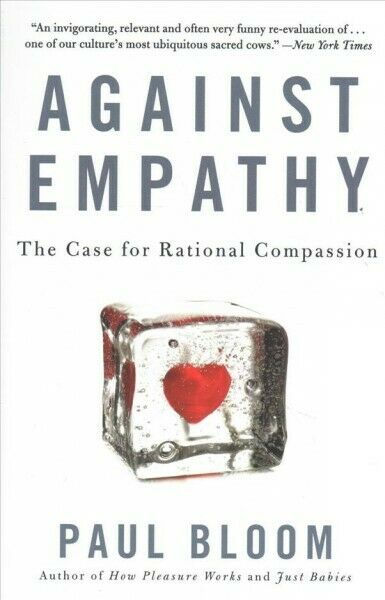
These provocative books constitute a three-front assault on some of our culture’s most deeply held moral convictions. Bloom’s attack on empathy and Asma’s attack on fairness stake out opposing positions in the ancient debate about the proper place of reason and emotion (the passions) in human life, and particularly in the pursuit of a morally good life. Bloom argues that in highly valuing empathy we grant emotion too great a role. It is an impediment to the impartiality morality demands. Our empathetic responses must be replaced, or at least constrained, by the rational, impartial consideration of the consequences of our efforts to help those in need. Asma, in contrast, argues that modern, Western culture is in thrall to a rationalist ideology of impartiality that subverts our natural moral sentiments. We should, he argues, embrace, rather than resist, our natural disposition to favor family and friends over strangers. Frankfurt rejects as rationally unjustified the virtually universal assumption that economic inequality is inherently morally objectionable. What should move us to act is not inequality but the absolute poverty often, but not necessarily, connected with it.
After examining the main arguments of these three volumes, I conclude the essay by suggesting that persons of Christian faith have good reason to support the project of bringing our cherished moral values, including justice itself, under critical scrutiny.
Against Empathy
The world, Paul Bloom baldly asserts, would be better without empathy, which he defines as “the act of feeling what you believe other people feel—experiencing what they experience” (3). While acknowledging that empathy moves us to act for the benefit of individuals who are in need, he contends that it “leaves us insensitive to the long-term consequences of our acts and blinds us as well to the suffering of those we do not or cannot empathize with” (9). “It does poorly in a world where there are many people in need and where the effects of one’s actions are diffuse, often delayed, and difficult to compute” (31). Actions induced by our emotional response to the pain and suffering of those familiar, similar, or close to us can lead to more suffering in the long run for those who are out of sight. Empathy is “innumerate and myopic” (31).
Bloom softens his stark claim, in part by narrowing his principal objection to the role of empathy in moral deliberation, in contrast to in our private lives, and in part by distinguishing empathy from compassion. When we see or hear of suffering, empathy is suffering which mirrors that of the other person. The empathetic person says, “I feel your pain!” In contrast, compassion, as he deploys the term, is simply “caring for other people, wanting them to thrive” (50). Compassion is also an emotional response, but not one that mirrors what the sufferer feels. It is characterized by feelings of warmth, concern and care that motivate one to improve the other’s situation. It is feeling for, not feeling with, others (138). Compassion is preferable to empathy, but both are “spotlights” that bring the particular, the here and now, into sharp focus, leaving much in the dark. What’s best is the intent to help, with or without an emotive dimension, regulated by the rational evaluation of the causes of suffering and of the overall, long-term consequences of efforts to mitigate it.
Human action intended to do good always risks bad, unintended consequences, but Bloom believes that actions grounded in feelings of empathy are particularly risky in this regard. Consider support for minimum wage laws. Beyond the empathy-inducing images and accounts of those laboring at low-wage jobs for less than a “living wage,” there are the many whose labor is not worth the new mandated rate and are put out of work, those who become unemployed because their employers, attempting to cover the new costs, go under, and the many young people who are denied entry to the work force because their lack of skills and experience makes employing them at the required rate an economically losing proposition.[1] A comprehensive examination of the effects of mandating minimum wages might, or might not, reveal that it is the best thing to do, but empathy is necessarily selective, focused on salient need and oblivious to unseen harm.[2]
Further, action grounded in empathy can have results that are morally good overall, but which are much less good than had we proceeded on a rational, objective examination of the needs we could meet. Our empathetic responses to family, friends, those who are nearby, and those with whom we are familiar create “tunnel vision.” Their needs loom large, moving us to care and act, while the much greater needs of those far away, out of sight, or different have little effect on us. A cute local child, showcased in the media suffering a deadly disease, arouses empathy, and donations for the costly, life-saving treatments pour in. We know that many more children in sub-Saharan Africa could be saved from dying of malaria by donating an equivalent sum to purchase mosquito netting, but this knowledge leaves us relatively unmoved.
In an obvious sense, it is worse for a million people to suffer than for one person to, but our innate emotion-driven responses don’t register this. As Bloom says, “we are not capable of feeling a million times worse about the suffering of a million than about the suffering of one” (108). The plight of family, friends, and those familiar and similar to us occupies center stage in moral motivation while that of the unseen many is drastically discounted, if not simply ignored.
Bloom does not endorse the full-fledged utilitarianism of Peter Singer, who argues that we are morally obligated to drastically reduce our standard of living, using our excess funds to save, and improve, the lives of the wretched of the Earth. For Singer, not to do so reveals a selfish partiality that irrationally regards the lives of others as less important than our own. Bloom acknowledges that there are moral considerations other than consequences, but confesses to not knowing how to weigh concern for the many that engender no empathetic feelings in us against the few that do. But he is convinced that empathy is a finger that should be taken off the scale.
Bloom reports that initially he regarded the objection to empathy as narrowly targeted on the public, moral domain. We should not want a president who feels our pain, but that is what we desire in our loved ones. However, to a degree, Bloom’s mind has changed and in Against Empathy he argues that in intimate human relationships, while we rightly hope for kindness, caring, understanding, and compassion, it is a mistake to want those closest to us to feel what we feel. At one level this is common sense. If I break my arm, I want my wife to care, but I don’t want her to feel the pain I am feeling. If I am depressed, I do not want her to be depressed too. Living with a depressed person will just make me more depressed. When someone panics, she should want those close to her to be calm, and when she is gloomy, she should want them to be of cheerful.[3] If someone suffers, it is good when someone else cares and provides aid and comfort. It does no one good when the suffering is contagious, and two people suffer.
Bloom might have achieved greater clarity if he had taken account of the standard analysis of emotions as structured mental states, integrating a “feeling,” which is a sensation or akin to one, a cognitive state, most often a belief, and a behavioral disposition. For example, anger is a feeling engendered by a belief about what someone has done, one that produces a disposition to do something in response. Bloom’s talk of one person’s emotion “mirroring” another’s obscures that fact that when, say, someone is sad because another person is sad, they have the same feeling but not the same cognitive or dispositional states, and in that respect do not experience the same emotion.
Bloom warns that unconstrained empathy leads to what he calls “unmitigated communion.” This is the state of the excessively emphatic person, someone who can’t be happy unless those with whom she personally interacts are happy and is thus incapacitated by their suffering (134). At the extreme, such an individual is afflicted with “emphatic distress.” She is intrusive, overprotective, and so fixed on the emotional state of others that she becomes incapable of helping them or caring for herself. The person in need needs effective help, not others who mirror his suffering. However, Bloom pays no heed to the possibility that this susceptibility is an essential, though inevitably risky, element of truly loving others.
A fundamental objection to Bloom’s denigration of empathy is to claim, as David Hume did, that “reason is the slave of the passions,” meaning, in this instance, that merely knowing what it is morally good to do does not move us to do it; moral knowledge without emotion is inert.[4] Divested of empathy, we would not be moved to act on behalf of the needy and suffering at all. Bloom rejects this, pointing out that, even if Hume is right, we can be motivated to help others without empathy. Passions more amenable to rational regulation, such as compassion, are more likely to result in morally good behavior. He writes that the distinction between empathy and compassion is essential to his argument (138), but this is not convincing. It appears that most of what he says against empathy counts about as much against compassion, and more generally against permitting emotion to play any significant role in moral judgment. Consider the case that could be made, for instance, against moral indignation. It’s easy to suspect that that moral sentiment has more deleterious effects than empathy.
Having argued that “we rely too much on gut feelings and emotional responses to guide our judgments and behaviors,” Bloom concludes with an optimistic account of the prospects for moral improvement if we defer to reason over feeling (213):
While we are influenced by gut feelings such as empathy we are not slaves to them…we can rely on cost-benefit reasoning…and we can recognize that a stranger’s life matters just as much as the life of our child, even though we love our child and don’t feel any particular warmth toward the stranger. (214)
A good deal of recent work in social psychology indicates that we are moved to feel, believe, and act by factors of which we are not conscious. Bloom refers to a study that shows that college students asked to report their political opinions tend to supply more conservative answers when standing near a dispenser of hand sanitizer.[5] Experiment reveals that we are subject to unconscious biases, including racial ones, but this does not mean that, made aware of them, we are incapable of consciously compensating for them. “Findings of [unconscious] racial bias shouldn’t lead us to forget that more rational processes exist as well and are deeply important” (226).
The “heuristics and biases” research project has revealed a variety of systemic defects in human reasoning. For example, we are inept at judgments of probability. Most people, asked which are more common, words ending in “ng,” like “song,” or words ending in “ing,” like “singing,” respond that the “ing” words are more numerous. This is impossible, since words that end with “ing” are a proper subset of words ending with “ng.” Despite such evidence, Bloom contends, “we are not as stupid as many scholars think we are” (216). These failures of rationality, though systemic, are not inevitable or universal. Human beings discovered them and, once alerted to this propensity for error, the rest of us can do better. In Bloom’s view, these “mind bugs” occur against a background of rationality. When we make decisions that affect our actual lives, for example, deciding where to go to dinner, choosing a school in which to enroll one’s child, or deliberating about whether to buy a house, we can, and often do, reason well, with no undue reliance on emotion. The hope, for Bloom, is that we will at least learn to keep empathy in its proper place, in our personal attachments, not infecting our moral judgment.
The slipperiness of the moral terms Bloom deploys can frustrate the reader. His differentiation of empathy and compassion may seem to some an arbitrary stipulation. He risks at least the appearance of incoherence. Although he begins the book by announcing that the world would be better without empathy, at its conclusion he writes, “I worry that I have given the impression that I’m against empathy” (240). One must pay charitable heed to the many qualifications he makes along the way in order obtain a reasonably consistent picture of what Bloom means to say. That effort is worthwhile, for what he has to say is important.
Against Fairness
While Bloom fears that empathy impairs impartiality, Stephen Asma in Against Fairness aims to downgrade the moral significance of impartiality, which he (somewhat misleadingly) calls fairness.[6] “Fairness unfairly dominates our culture and crowds out the virtues of favoritism” (162). Fairness, whether conceived in meritocratic or egalitarian terms, must be dethroned in favor of the virtues of preference: filial devotion and duty, loyalty, and allegiance to, even bias in favor of, family and friends. He does not deny fairness its proper place. Government ought to exercise its legal authority impartiality, umpires ought not to play favorites, and—difficult as it may be—professors ought to evaluate students’ work impartiality. Yet in much of life there is no explicit, and should be no implicit, commitment to impartiality. Often, it is fine to be unfair.[7]
Asma offers the example of someone who owns a tavern that features live entertainment. The owner hires various bands to play, generally selecting them on the basis of their musical abilities. However, his brother, who is hard up, leads a band that is not very accomplished. Normally, the owner would not hire this low-quality ensemble, but he does, because he wants to help his brother out (57). Asma judges that this is unfair to better bands that might have been hired instead, yet not wrong. Indeed, it’s the right thing to do. Brotherly affection rightly trumps fairness.[8]
Pushing the example further, Asma tells us that the owner pays his brother more than he pays the other bands (58). For all he knows, they might be in the same, or greater need, but he favors his brother just because he is his brother. This, says Asma, is also laudable unfairness.
Finally, the tavern owner pays his brother, who distributes the proceeds for the gig equally among the musicians, but only after he holds back $20, which he puts aside to help pay for the braces his daughter needs. Once again, this unfairness is fine with Asma. There is no moral objection to favoring your daughter in these circumstances.
Asma makes a different judgment about an actual case, that of the media magnate Rupert Murdoch who purchased for his publicly owned company a television production company owned by his daughter. The daughter garnered $320 million from the sale, and Murdoch was accused of overpaying so as to benefit his daughter. Asma first asserts:
Murdoch has been entrusted with other people’s investment money, and a such they have claims on him. But he still has to weigh his ‘fatherhood duties’…against his management duties toward non-relations…It’s still no contest, given the disproportionate moral gravity of one’s child. Public be damned, if one’s daughter can profit. This is the legitimate operating principle of favoritism. (68)
However, the scope of this principle is not unbounded. In contrast to the case of the brothers, he concludes that Murdoch’s favoritism was illegitimate: “Murdoch’s daughter is so obscenely advantaged and recklessly compensated…that it seems off the map of decency” (68).
Asma acknowledges that he can offer no more perspicacious rationale for commending the brothers’ favoritism while condemning that of Rupert Murdoch. Reason is not up to the task of discerning when partiality goes too far. We must learn to live with the cognitive dissonance of valuing both fairness and impartiality. “On some things, you will simply have to choose between what is loved and what is fair” (150).
However, Asma’s examples omit crucial detail that determines whether the preferential treatment is morally right. We need to ask whether the nepotism he describes wrongs someone, say by deceiving or cheating him. Did the owner of the tavern lead the bands to believe that his hiring decisions would be made entirely on the basis of musical ability, as though he were a judge in a contest? Most likely, not. A reasonable person, unless advised otherwise, would take it for granted that virtuosity is one criterion among others, and that a musically inferior band might be hired because its members are so attractive, they intersperse their numbers with amusing commentary, they are locally popular despite being musically less accomplished, show up on time, or consume less free beer than the better bands. Or because the owner’s sibling leads them. On reasonable assumptions, the superior band that was not hired has not been deceived, cheated, or otherwise wronged, and Asma is right to say that the owner’s nepotism, his “unfairness,” is morally acceptable. Similarly, unless the other bands that have been hired have taken the gig on the condition that every band will receive the same pay, the brother’s band being paid more is not a moral problem. And, unless the members of the brother’s band have agreed to play on the condition that the proceeds will be distributed equally among them, his taking an unequal share does not wrong them.[9]
In contrast, Rupert Murdoch has an obligation to manage the company in whatever way increases its value and the value of the shareholder’s stock. If he believes that the purchase of his daughter’s firm for a large sum is not the optimal investment for the company, he has cheated his investors.[10] If Murdoch’s nepotism was wrong, it was not in virtue of the amount of money involved but because he cheated the corporation’s shareholders, violating our common assumptions about the fiduciary responsibilities of officers of publicly-owned enterprises. Asma can reasonably say that it is permissible to treat people in ways he describes as unfair, but not that it is permissible to wrong them for the sake of benefiting one’s favorites.
If Asma’s point is that unfairness, i.e., partiality, nepotism, and favoritism are permissible in the absence of wronging, then it is true but trivial. If the point is that what he calls unfairness is permissible even when people are being cheated or defrauded, then he is mistaken. Impartiality is sometimes morally required when explicit agreements are in force, or when individuals fill well-defined roles, while in any number of other cases it is not expected and not required.
The contest between societally expected impartiality and our natural partiality is easier, it seems, to resolve rationally than Asma supposes. Partiality rightly trumps impartiality in any number of cases, but—extreme cases aside—it ought never trump the obligation not to wrong people. Of course, someone might contend that partiality as such is wrong, but if there is a reason to believe so it is not obvious.[11]
Asma goes to some length to show that our partiality to those genetically closely related to us, parents, children, siblings, spouses, cousins, etc., and unrelated people with whom we have chosen to share a common history, i.e., friends, is a biological fact of human nature. We are not, by nature, egoists. “We don’t come into the world as selfish Hobbesian mercenaries” (39). But neither are we naturally inclined to care about other human beings indiscriminately. Beneath the current cultural overlay, we are tribalists, strongly disposed to favor kith and kin. Western culture advertises an official allegiance to fairness, but we exhibit a “cringing willingness to look the other way at minor infractions.” However, as in case of the family-favoring brothers, these infractions are not “tolerable failures” but positive moral goods (58).
On Asma’s account, the demand for impartiality, for equal concern for humanity as such, is an anomaly, an unsustainable conflict with human nature. “Elite, white college-educated people are the only demographic that sees morality primarily as a matter of fairness” (89). Non-western cultures have not lost the virtues of preference the West needs to reclaim. Asma, who has lived in China and Cambodia, describes with approval a different moral universe, one in which all ethical concern originates in the bond between parent and child and from this extends to other family members and to more distant relatives. From this moral center arises concern for friends, neighbors, countrymen and, magnanimously, even for persons with whom one has no connection. “The model of the good person is not the saintly world-savior, but the devoted family member” (102). He sees it as his duty, say, to hire the less than competent nephew rather than the highly competent stranger. What Westerners see as corruption or something close to it the Asian sees as high virtue. In contrast to this natural way of being human, Asma sees our fixation on disinterested impartiality as impoverished. Asma does not assert, and we need not believe, that Asian cultures are overall morally superior to ours to agree that our elevation of impartiality is unwarranted.
An obvious objection is that neuroscientific facts do not imply anything about what’s morally right—‘is’ does not imply ‘ought.’ The evolved human brain is a natural nepotist, but perhaps we ought to constrain our tendencies to partiality and strive for fairness. No doubt, this would be Paul Bloom’s view. Asma’s response is to acknowledge that “favoritism is not good just because it is natural,” but to remind us that it is self-evident that love is part of a good human life and love is inherently preferential (46). Quoting George Orwell, he states the obvious: “love means nothing if it does not mean loving some people more than others (6).[12]
Asma’s main target is the undue weight we accord fairness in private life. What of fairness in the public realm? Asma acknowledges the necessity of formal, legal equality. Government does, or at least ought to, require of each citizen the same compliance with its laws. Thus, it must reciprocally treat all citizens the same way unless there are relevant differences. Presidents who play favorites are no more desirable than ones who feel our pain. The one area where Asma delves into policy matters is education. He excoriates the obsessive egalitarianism that in the schools leads to such absurdities as athletic “contests” in which everyone gets a trophy, so there are no losers, a boy not being permitted to give a Valentine’s day card to the little red-haired girl with whom he is besotted unless he gives one to everyone, and kids not being permitted to have a “best friend.” Losing a game, not getting as many valentines as other classmates, or having a favorite classmate is condemned as unfair. The worthy attempt to instill open mindedness, tolerance, and respect for those who are different runs off the rails when it morphs into the project of stamping out all preferences as unfair. Children indoctrinated against partiality are not prepared for adult life, where some of us are worse than others at some things and less popular than others and treated accordingly. To prefer what is near and dear, one’s family and friends, one’s region, nation, ethnicity, to others is not to be a bigot who treats others unjustly. Nor are they well-prepared for citizenship. “What kids owe one another is respect, not equal affections or equal treatment” (95).
Asma has little else to say about matters of public policy, but it would be interesting to hear his views on the economic nationalism embodied in the current “America first” rhetoric. Is it right, for instance, to enact trade policies that transfer jobs from American to foreign workers? This might be justified on utilitarian grounds; the misery caused by closing factories in America’s “rust belt” might be more than offset by the benefits for impoverished folk in Sri Lanka, but should we nonetheless favor American workers simply because they are our fellow Americans?[13]
In one regard Against Fairness and Against Empathy are mirror images. Bloom’s concern is that our emotional response to individual instances of suffering can make us morally myopic, oblivious to the large and long-term consequences of the actions to which empathy leads. Asma’s concern is that modern Western’s culture ideology of impartiality threatens indispensable moral virtues, e.g., loyalty, devotion, allegiance, and that it is self-undermining, insofar as it denigrates the underlying “tribalism” in which any motivation to care for others is ultimately grounded. Myopia, he says, is necessary for clear moral vision.
Against Equality
Perhaps the most controversial of the three books, Harry Frankfurt’s On Inequality, might well have been titled Against Equality. The three are worth reading together for the challenging encounter with reasoned criticism of deeply entrenched, unquestioned—some would say unquestionable—moral values of contemporary society, but of the three this is the one I’d most recommend for its own sake. It’s the shortest and simplest but most clearly reasoned, although its brevity leaves unanswered many questions it raises.
Frankfurt’s straightforward claim is that equality or inequality of outcomes, particularly economic outcomes, has no moral significance.[14] “What’s morally objectionable in circumstances of inequality is not that some of the individuals in these circumstances have less money than others. Rather, it is the fact that those with less have too little” (41). Thus, we do not find great disparities of wealth among the very rich morally problematic. It is not quantitative discrepancy but absolute deficiency that actually, and rightly, troubles us (42).
The fact that someone is rich and someone else has much less does not morally matter and gives us no moral reason for concern. In an intellectual and political climate in which disparities of wealth are perceived as a pressing moral issue, this sounds like heresy. Frankfurt’s contention is that equality seems significant because it is closely associated with other things that are morally significant. In the obvious case, economic inequality is associated with human need and suffering, which we are morally obligated to care about. Frankfurt does not try to prove that inequality has no inherent moral significance. His fundamental argument is rhetorical: once we distinguish inequality from insufficiency, not having enough, isn’t it clear that it’s not inequality as such that should concern us? One might, of course, acknowledge the distinction but insist that while need—absolute poverty—is distinct from relative poverty—having much less than others—both morally matter. The question, however, is what reasons could be supplied to believe this. Frankfurt plausibly holds that there are none.
A classic thought experiment asks us to imagine two societies, one in which there is a high degree of economic equality: no one earns significantly more or less than the average annual wage, which is $1000. The other is characterized by great inequality: the top ten percent earn $10 billion a year while the least well off get by on a mere $1 million a year, orders of magnitude less. Assuming that a dollar has the same purchasing power in both, which society would a reasonable person prefer to live in, assuming one’s economic station is randomly assigned? The “poor” living in the unequal society are, in absolute terms, vastly better off than those in the egalitarian society. Almost any aim a human has in life, including those that do not require the accumulation of material possessions, can be more successfully pursued in the richer society. That most people would prefer having more, absolutely, even if it means having relatively less than others, does not prove that inequality in itself has no moral importance, but it certainly puts the burden of proof on those who claim otherwise.
As Robert Nozick famously said, maintaining economic equality demands pervasive restrictions on liberty. Without systematic coercive restraints on “capitalist acts between consenting adults,” inequality inevitably ensues.[15] Frankfurt notes this objection to the pursuit of economic equality but does not rely on it as an argument against valuing equality. What Frankfurt instead regards as of fundamental importance is egalitarianism’s effect on persons’ self-identity. He contends that when economic equality is valued for its own sake, people tend to measure their well-being in comparison to what others have, rather than attending to “what is needed for the kind of life a person would most appropriately and sensibly seek for himself” (11). This separation of the individual from his genuine needs and desires is self-alienating. If we want more merely because others have more, our desire is not authentically our own. Perhaps envy, which deserves no moral consideration, is the extreme manifestation of the inauthenticity Frankfurt warns against.
A more prosaic negative feature of economic egalitarianism Frankfurt does not address is that it often arises from, and perpetuates, deleterious economic ignorance. Many implicitly believe that the economy is a “zero-sum” game, i.e., that one gets richer only by making someone else poorer. If it were true that I have so little because someone else has so much, I could rightly feel I am the victim of injustice, one that enforced equality can rectify. There are economic systems in which this belief is true, but it is not true of free-market economies, those in which the only way to get richer than others is to be better at supplying people with what they want or need. Each economic transaction makes both parties better off. Bill Gates got to be much richer than almost everyone else because he provided us with something we decided was worth more to us than the money we paid for it. The real world approximates the thought experiment considered above. A market society in which individuals are permitted to accumulate vast wealth is one in which the least well-off are better off than they would be if equality was enforced.[16]
Frankfurt argues effectively against the view that the equal distribution of wealth reliably maximizes overall utility, the sum of human happiness.[17] Redistributing income makes the small number of rich people unhappy, but it makes the larger number of poor much happier. This argument relies on seemingly obvious facts about diminishing marginal utilities. When a poor person gets an extra $10,000 this will noticeably improve his life, but getting the same amount means little to the millionaire. Thus, better for the poor person to get the $10,000 by transferring it from the rich person. However, Frankfurt points out that while money is essentially worthless in itself, it is valuable as a universal medium of exchange, and thus this reasoning does not apply to it. If I have one pancake for breakfast, I’d be happier if I had a second one, but if I’ve already eaten ten pancakes one more is not likely to be appealing. When I am sated, the eleventh pancake is worth much less than the second was when I was not yet full. However, unlike pancakes, money can easily be exchanged for something new and different, for practical purposes without limit. As the adage says, one can never be too rich; more money is always better.[18]
As Frankfurt notes, threshold effects can undermine utilitarian arguments that invoke the law of diminishing returns. Getting an extra $1000 to put into the account in which you are saving up to buy a yacht makes you happy with anticipation, but you get much more—not less—satisfaction from getting the final $1000 that at last puts the boat within reach.
Further, even if, as utilitarians say, there is a general moral obligation to increase overall utility, there is no guarantee that an equal distribution does so. If 100 sick people will die unless they receive a specified dose of some pharmaceutical, it might be that if each receives an equal dose, no one gets enough, and everyone dies. Some lives can be saved only if some get no medicine and die.[19] Even, indeed especially, in matters of life and death, an equal distribution can be wrong.
These considerations effectively refute the assumption that equal distributions are guaranteed to increase utility, i.e., overall human happiness. However, the egalitarian most likely will acknowledge that equality does not necessarily maximize utility, but contend that in many cases it does, and that in our society an equal, or more equal, distribution of wealth would do so. To oppose this, what’s required are not abstract arguments about utility, but a focus on the economic policies that make the least well-off better off in absolute terms.
Sufficiency, for Frankfurt, is defined in psychological terms. A person has enough when she is content with what she has. She is not disposed to do much of anything to obtain more; she is not, for instance, seeking a higher paying job. She is not dissatisfied with her current economic state. This is not to deny that if she had more, she would not be happier, enjoying a higher level of satisfaction, but she is satisfied with her level of satisfaction; she has no serious interest in trying to become better off economically. Readers familiar with Frankfurt’s influential account of freedom will note a resemblance. In On Inequality, economic sufficiency has a similarly second-order structure. He holds that a person is free just if she can do what she wants and wants to want what she wants. To be free is to have this second-order desire. Contrast the person who wants to smoke but does not want to have the desire to smoke with the person who wants to smoke and wants to continue having this desire; the latter, but not the former, freely chooses to smoke. The unfree smoker, like the individual who wants more merely because others have more, lacks a fully integrated, authentic self.
Many would find Frankfurt’s account of sufficiency insufficient because he does not address the issue of how much is enough in objective, material terms. Suppose someone coming from a long line of impoverished people is entirely satisfied in a state that the rest of us would regard as intolerable. He lives, say, in a shack in an isolated Appalachian valley, cannot afford indoor plumbing, trips to the dentist, or much more than grits and fatback to feed his family; yet he is perfectly content. He has no desire to do anything to improve his economic situation. Does he have enough? Shall we say that he has too little because he ought to be dissatisfied? Suppose someone is already very wealthy, but is discontent with his state, always seeking ways to get richer. Or suppose someone who, while not rich, has a well-paying job, but is dissatisfied with it and tries for one with better pay. Are these cases of insufficiency that should trigger moral concern? Further, although it is absolute, not relative, inequalities that, according to Frankfurt, morally matter, it’s hard not to believe that what others have is not relevant. When only the rich had central heating, air conditioning, a car, a telephone, or a television, these were luxuries the lack of which was not a moral issue. But now that almost everyone takes these things for granted, is not having them a mark of insufficiency? Does someone’s lack of them create an obligation to help? These are questions that must be answered if we are to shift the focus of concern from inequality to insufficiency.
Frankfurt objects not to inequality, but to the need that can accompany it. However, what can also accompany inequality is what he calls “economic gluttony.” The behavior of some who have vastly more than they need to live comfortable lives is a “ridiculous and disgusting spectacle” which is morally offensive, especially when juxtaposed with large numbers of persons suffering economic deprivation (4-5). He does not expiate on what sort of response to this is appropriate. Nor does he clearly differentiate wealth that is excessive in itself, if there is such, from its use in the ways he deplores. Given his sensitivity to the actual effects of economic policies, it seems unlikely that he would recommend coercive government action similar to the intervention many proponents of economic equality propose. There are forms of behavior that are morally offensive but do not justify forcible intervention in contrast to criticism, derision, shunning, shaming, boycott, and other non-coercive sanctions. In this case, the reasonable concern is that the attempt to regulate the lifestyles of the rich and famous could be counterproductive. For hardly anyone, no matter how gluttonous, eats his money, nor does he hide it in his mattress, bury it, or burn it. Instead, he either spends it or invests it in hopes of making even more. If he spends it, even to buy the most absurd luxuries, he employs persons less rich than he is to make, deliver, and service what he buys. His maid judges she is better off being paid to polish his solid gold bathroom fixtures than not doing so. Money he invests is lent to others who use it to buy things, or to create or expand businesses. In either case, the money goes to pay workers whose lives are thereby improved. In a market economy, it is difficult for the rich, no matter their personal moral failings, not to benefit the poor.[20] Possibly, the poor would be better off if the excess wealth, on whatever criterion we can come up with, was simply confiscated and directly redistributed to the poor. But this is far from obvious, at least to those less than sanguine about government efficiency. Also, the economic system that makes great wealth possible, and the legal system in which people are free to use it as they see fit, even foolishly, are the same systems in which some with great wealth live modestly and engage in philanthropy that benefits those in need.
In passing, Frankfurt acknowledges that great inequality of income often translates into unjust disparities of political power, and thus threatens democracy. He judges, “the potentially undemocratic effects of this advantage must be dealt with…by legislation and regulation designed to protect these processes from distortion and abuse,” not by aiming for economic equality. He does not address the question of how such legislation and regulation can be put in place if the rich already exercise undue influence.
Eventually, Frankfurt moves beyond economic inequality to inequality in general, and there devises a parallel argument. We saw earlier that Asma asserts that it is not our duty to treat everyone fairly, but to treat them with respect. Here, Frankfurt claims that we have no duty to seek equality in general, but it is our duty to treat everyone with respect. Persons being treated the same way others are treated has no inherent value and is often morally wrong. What morally matters is treating people with respect, which is to treat them in accord with their morally relevant characteristics. He writes:
The most fundamental difference between equality and respect has to do with focus and intent. With regard to any interesting parameter—whether it pertains to resources, welfare, opportunity, rights, consideration, concern, or whatever—equality is merely a matter of each person’s having the same as others. Respect is more personal. Treating a person with respect means, in the sense that is germane here, dealing with him exclusively on the basis of those aspects of his particular character or circumstances that are actually relevant to the issue at hand. (77-78)
For Frankfurt, to treat persons with respect is to advantage, or disadvantage, them only in light of their relevant personal characteristics, in light of what each deserves. If everyone deserves the same treatment, then they ought to be treated equally. If individuals differ in ways that in the context matter, then they ought not to be treated equally. To treat someone as though her relevant individual characteristics do not matter is to fail to respect her for who she is. It is to say that what’s true of her as an individual, good or bad, is of no consequence. If the state denies me a driver’s license because I fail the exam, even if everyone else passes, this differential treatment is not unjust. But if it denies me the right to drive because it does not approve of the political cause my bumper sticker endorses, the differential treatment is wrong. Blindness is, but deviant political views are not, relevant to whether I should be permitted to drive.
An issue of great practical significance Frankfurt does not address is the perennial difficulty of ascertaining which features of individuals are relevant in particular situations. Moral and policy controversies are disagreements not about whether all people deserve equal respect, but about what differences are relevant. Until its resolution by the United States Supreme Court in 2015 debate raged as to whether the fact that a couple aspiring to marry were of the same sex was a relevant consideration that would justify a state denying them a license. Some factors are plainly relevant, for example, the two seeking the license have the same parents, while others are plainly irrelevant, say they both belong to the Reformed Church in America. But the relevance of the applicants being a same-sex couple was a matter of serious dispute.
On Inequality is the kind of book that makes me wonder why its principal claims were not already obvious before I read it. I think it’s likely others would have the same response.
And Justice Too?
All three of these books are to some degree open to the criticism that they target straw men. Some may insist that what they call empathy is not the problematic emotion Bloom attacks, but merely a reasonable concern for others. Against Asma some may claim, as I suggest above, that when they reject unfairness, what they have in mind is just deceiving, defrauding, or otherwise treating people unjustly. And egalitarians may contend against Frankfurt that their rhetorical commitment to equality expresses no more than a sober concern for human need and suffering, not a demand for equality for its own sake. Still, to whatever extent these are candid responses, we can at least credit Bloom, Asma, and Frankfurt for requiring us to think more carefully about the shape of our moral commitments.
Beyond that, these authors help us recognize that seemingly inviolable moral commitments can seriously be called into question and, if not abandoned outright, criticized and downgraded, revealed as not having ultimate and unqualified claims on us. Rather than being inevitable and eternal, they may reflect the ideals of our particular place and time. Whatever Christians make of the specific arguments Bloom, Asma, or Frankfurt advance, we rightly endorse the project of bringing our values under critical scrutiny. Our morality, like our religion, can be put to use by the God who condescends to us in our fallen state so as to save us from the power of sin and death, but it always stands under divine judgment.
Nothing occupies so central a role in our repertoire of moral concepts as justice. Concern to discern the actual claims of justice underlies the arguments of our three authors. Bloom aims to show that empathy is at least as likely to impair the quest for justice as to motivate us to achieve it. Asma argues that partiality, favoritism, nepotism—what he calls “unfairness”—is not necessarily unjust. And Frankfurt contends that economic inequality is, in itself, not unjust.
Yet, it is justice above all that the Christian gospel subverts. The Christian gospel is dramatically at odds with our moral conviction that everyone ought to get what she deserves, evil for evil, good for good. Denying justice its due, the Christian faith is a moral scandal. It denies God the role our natural religiosity assigns him. From a human perspective, justice trumps all other considerations.[21] We say, “Fiat justitia ruat caelum—let justice be done though the heavens fall!” Each must receive his just deserts, good or bad. Yet, our faith is that the heavens have fallen, God has come down to earth. In the name of justice he was put to death by the religious and political powers for blasphemy and sedition. The cross of Christ mocks and defeats our justice, and his resurrection reveals its ultimate defeat. For God’s justice—the righteousness of God—is nothing less than his unfailing faithfulness to his beloved creatures, decisively demonstrated in the life, death, resurrection, and ascension of Jesus. It is not a cosmic keeping of accounts that must somehow be reconciled with his love; his justice simply is his unbounded grace and mercy.[22]
A recurring promise of Scripture is that God will set the prisoners free. Yet he does not differentiate between those deservedly, and thus justly, incarcerated, and those unjustly imprisoned. Repudiating the just demand of an “eye for an eye,” Jesus says, “I tell you not to oppose the wicked man by force; rather, whosoever strikes you upon the right cheek, turn to him the other as well” (Matthew 5:38-39). Does this mean that it is really wrong to hit back, that the attacker does not deserve counterattack, or that we should never inflict on him what he deserves? Denying justice its due, shall we throw open the prison doors, freeing the wicked man? Liberated, he walks down the street where he hits you; you don’t stop him, but let him hit you again, harder. While you lay dazed on the ground, he proceeds down the street to assault a grandmother and her grandchildren. God’s ultimate judgment against the justice so dear to us does not call for throwing the innocent to the wolves of this world. [23]
Our vocation is not to make immanent the eschaton, but to bear witness to the coming kingdom to which Jesus calls us, seeking places where God’s mercy and forgiveness can break into this fallen world’s order of moral rigor. As persons of faith, our commitment to justice in this present age cannot be wholehearted. To accord justice—or any other moral value, such as empathy, fairness, equality—an absolute status is to depart from God’s purposes. In light of the Gospel, all else is made relative and denied the final word. Yet in the here and now, “between the times,” when God’s defeat of the power of sin and death is already, and not yet, completed, we cannot live without acting on our moral values. Least of all can we simply dispense with justice. To adhere to the Gospel is to learn to navigate this world with the double vision that neither summarily dismisses justice nor grants it the absolute status we are naturally inclined to give it.
Faint as the voice of faith might be in the public, political domain, we can speak out, according the state merely the mundane power to keep the peace and, when it punishes, denying it the authority to exact justice, carrying out retribution on wrongdoers, and insist that legal punishment always be preventative, deterrent, or rehabilitative, never retributive, never an attempt to enact justice. Such authority belongs to God alone, and he eschews it for the sake of those he loves. Yet we must speak equivocally, denouncing the state when it punishes the innocent, or deals with the guilty more harshly than necessary for public safety.
In our personal and professional lives, we suffer injustices, large or small. Our culture reinforces our passionate innate desire for justice, to stand up for ourselves, to obtain our just desserts, yet in faith lies freedom to forego demanding it. Freely chosen sacrificial forbearance bears witness to the coming kingdom when human justice will be no more, and grace and mercy will be all in all.[24]
[1]As I write this in the summer of 2020 a timely example is the current demand to defund or even abolish police forces, motivated by the brutal killing of an unarmed black man while resisting arrest and the strong empathetic reaction it caused in millions of people. Against the countervailing evidence, this was widely taken as confirming a narrative in which police are systematically killing unarmed Black men. Predictably, curtailment of policing leads to far more deaths of innocent Black persons than have been killed by law enforcement. But for many these are mere statistics, lacking emotional weight.
[2]In keeping with Bloom’s practice in most of the book, here I ignore moral considerations that some see as competing with or even overriding considerations of consequences. For example, some might contend that there is an objectively “just wage,” and that those paid less are being treated unjustly. Others will regard government control of wages as an unjust violation of the rights of employees and employers to reach voluntary contractual arrangements.
[3]So says Bloom, but I suspect the gloomy person often feels worse when surrounded by the cheerful.
[4]A Treatise of Human Nature, Part III, §3. Selby-Bigge, ed. (Oxford: Oxford/Clarendon, 1897 [1739]).
[5]Perhaps this will inspire liberals to demand that such dispensers be removed from polling places.
[6]I find this misleading because I would not describe departures from impartiality as unfair unless they are unjust. In contrast, Asma regards some actions as unfair, yet not unjust. I find the concept of “just unfairness” oxymoronic because to me to describe something as unfair is to make a negative moral judgment, to call it unjust. But what seems to me Asma’s idiosyncratic use of the moral vocabulary does not impair his argument.
[7]Asma points out that the great moral teachers, even Jesus, who had a favorite disciple (presumably John the Evangelist), indulged in partiality (3). And, lest we suppose that impartiality has divine sanction, he reminds us that in the Old Testament God had a chosen people (7). Christians can agree that it was entirely fitting that the incarnate God, who was fully human, had friends, some closer than others. But we will note that God’s partiality toward Israel—“a light to the nations” (Isaiah 49:6)—was always in the service of his grand project of salvation for all humankind.
[8]Anyone who has evaluated candidates for a position realizes that examining the resumes of strangers and conducting interviews are at best fallible ways of discovering the best candidate. The individual responsible for the decision may well take for granted that the applicant pool contains candidates who would do a better job than his relative, and perhaps others who would do worse. Knowing his brother well enough to know he would do a good enough job, he hires him, following the “mimimax” strategy often appropriate for making decisions under uncertainty. He thereby ensures that he avoids the worst case, viz., hiring someone who does a lousy job.
[9]Judgments of right and wrong are not context free, but depend on a society’s vast, intricate, and mostly implicit network of understandings. When, for example, you have dinner at a restaurant, no sign on the door or reminder from the maître d’ informs you that you are expected to pay for your meal before leaving, yet it would be wrong to leave without paying the tab. A student enrolled in a course takes it for granted that the professor ought to assign grades without partiality in light of criteria stated in her syllabus, even though it does not say she will do so.
[10]Here, as in the imagined case of the nepotistic tavern owner, partiality might have been justified. Trust is a significant factor in economic transactions, and knowledge of a company under consideration for acquisition is necessarily incomplete. Generally, we trust family members more than strangers, and it can be reasonable to favor them, even when investing other persons’ money. Murdoch’s nepotistic acquisition might have been the best way for him to discharge his fiduciary responsibilities to his shareholders. In the actual case, Elisabeth Murdoch had a mixed record of success and setbacks in the media business.
[11]One tradition seeks to ground impartiality in rationality: if I advantage one person but not another when there is no relevant difference between them, then I act without good reason. However, relevant differences are so easy to come by that no case can be made for universal impartiality. I might do something good for one person but not for another for the perfectly good reason that I like the one and not the other. It is only in special circumstances, e.g., one is a professor assigning grades, an umpire calling balls and strikes, or a government official, that relevant differences, and thus permissible reasons for differential treatment, are specified in advance.
[12]He takes Orwell’s words from “Reflections on Gandhi” in The Orwell Reader (New York: Mariner Books, 1961), 331.
[13]A book similar in spirit to those reviewed in this essay is Yoram Hazony’s The Virtue of Nationalism (New York: Basic Books, 2018). He does not attack an established moral value but, as the title indicates, praises nationalism, economic and otherwise, which is currently widely regarded as an unmitigated evil.
[14]Although Frankfurt’s focus is on equality of outcomes, e.g., some are rich and some are not, his reasoning can readily be applied to equality of opportunity. We should not be concerned that some people, due to undeserved differences of natural endowment, upbringing, and good luck have opportunities others lack, so long as everyone has sufficient opportunity. If we value the Unites States as a land of equal opportunity, this is not plausibly regarded as more than the absence of arbitrary legal or entrenched social impediments to achieving one’s goals, with the result that everyone has plenty of opportunity.
[15]Anarchy, State, and Utopia (New York: Basic Books, 1974), 160-64.
[16]Patterns of immigration suggest that many of the world’s poor judge that their lot would be improved by occupying the lowest economic rungs of a nation with both great wealth and great inequality.
[17]Frankfurt takes on these utilitarian arguments on their own terms, but were any of them to succeed, this would not overturn Frankfurt’s basic claim that equality has no inherent moral value, irrespective of whatever instrumental value it might have.
[18]No doubt, those who reach satiation only with the tenth pancake need not worry about being too thin either.
[19]In such a case, it is morally required to devise some just method for deciding who lives and who dies, and while that might be giving each patient an equal chance to get the drug, some other criterion might be morally superior, e.g., save the youngest, the nicest, or those on some criterion most valuable to society, such as physicians, tavern owners, or philosophers.
[20]John Rawls, in his very influential A Theory of Justice (Cambridge: Harvard University Press, 1971), argued that a just society permits inequalities of wealth only if doing so benefits the least-well off members of society. Critics to his left, realizing how easily this criterion is satisfied in a free market economy, regard Rawls as insufficiently committed to equality. On the right the objection is that the criterion is too strong, and that inequalities of wealth should be permitted so long as they do not harm the least well-off members of society. I do not mean to suggest that any actual society perfectly realizes the ideal of a free market. Many make money the old-fashioned way, such as by colluding with governments to restrain competition, rent seeking, fraud, and outright theft.
[21] Thus, the familiar, but unbelievable, teaching among Christians that the execution of Jesus, the innocent victim in place of the guilty, satisfies divine justice. To punish an innocent person for another’s wrongdoing is not just; it overturns justice.
[22]The Septuagint, the third-century BCE Greek translation of the Hebrew scriptures, used the Greek term dikaiosynē for what in English translations is the righteousness of God. Because dikaiosynē was defined as a person getting what he deserves, this obscured the crucial fact that God’s “justice” is in reality not a superior version of what we call justice but essentially different from it and ultimately at odds with it.
[23]Even while rejecting a thoroughgoing pacifism as Christian witness, we could nonetheless respect someone who consistently repudiates the use of force because he regards doing so as God’s desire. But what’s called pacifism is almost invariably incoherent, rejecting the use of force in national self-defense while enthusiastically supporting its domestic use by government for purposes deemed worthy, e.g., to secure tax revenue for welfare programs. The closest we can come to a credible pacifism is classical liberalism’s conviction that it is never permissible to initiate violence, but that it is permissible to resort to it in response to those who do initiate it.
[24]Thanks to my colleagues in the Northwestern College reading group, whose insightful discussion of Bloom’s Against Empathy gave me the idea for this essay.
v



Comments